Supporting Working Carers and Local Schools: What Employers Should Do in 2026
Schools can't carry this alone and the adults who could help are on your payroll
It starts at 8:40am

Somewhere in your organisation this morning, someone sat in a school car park with the engine running. Their child would not get out of the car. They arrived at their desk forty minutes late, composed, and said nothing about it.
A mile away, a headteacher began the day with that same child on an absence list, a teaching assistant off sick, and a parent who had stopped answering the phone.
Those two people are working on the same problem from opposite ends. They will almost certainly never speak to each other. Your organisation sits between them and it is the only one of the three with any slack left in the system.
This article makes an ask, and it is not for a donation. It is for the thing schools are shortest of and employers quietly hold: time, governance capacity, and adults who know how to hold a difficult conversation well.
What the 2026 SEND white paper means for employers
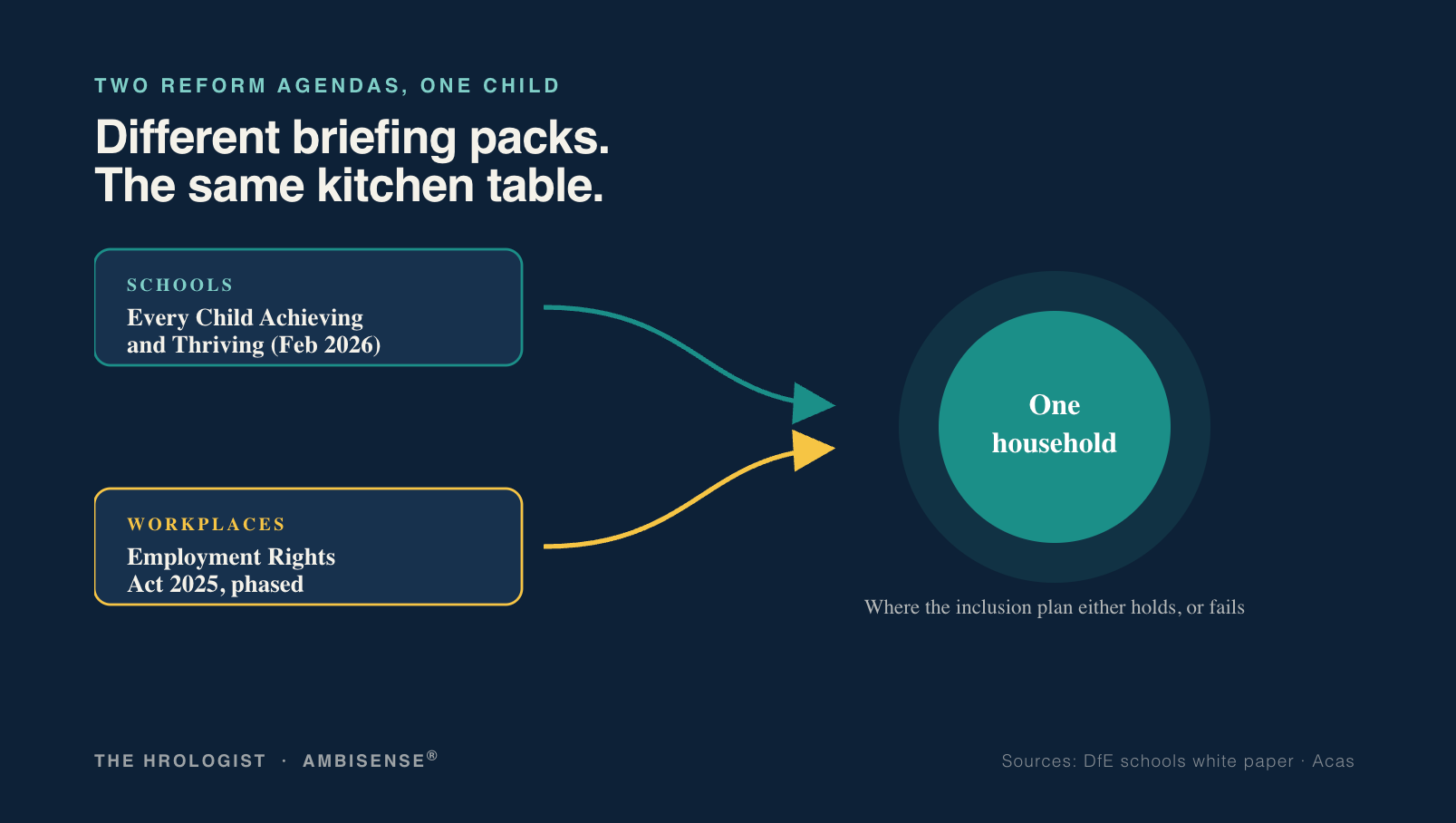
You were almost certainly briefed on one of 2026's two reform programmes and not the other. They are about the same families.
In February, the Department for Education published its schools white paper, Every Child Achieving and Thriving, with a major section on reforming special educational needs and disabilities provision in England. In December 2025 the Employment Rights Act 2025 became law, with measures phased across 2026 and 2027.
Read side by side, the two agendas are describing one household.
Theme
In schools
In workplaces
Early support
A proposed legal duty to put an Individual Support Plan in place for every child with identified SEND, alongside National Inclusion Standards (DfE)
Paternity leave and unpaid parental leave became day-one rights on 6 April 2026 (Acas)
Workforce capability
Over £200m of SEND training for all school staff, available from September 2026 (summary for school leaders)
A government review of carers' leave reports in January 2027, with paid carers' leave and a 'right to return' on the table (Osborne Clarke)
Money and enforcement
A £1.6bn Inclusive Mainstream Fund from 2026/27, paid directly to schools for early intervention without formal assessment
The Fair Work Agency was established on 7 April 2026 as a single enforcement body (Lewis Silkin)
Risk and exposure
Updated statutory attendance guidance from 9 July 2026, expecting targeted support before punitive measures
Employment tribunal time limits extend from three months to six from October 2026 (DavidsonMorris)
The child in the left-hand column and the employee in the right-hand column often share a kitchen table. Treat the two columns as separate projects and you will fund both badly.
Why supporting working carers is a retention issue, not a CSR one
If you need a commercial reason before a moral one, the data is already on your desk.
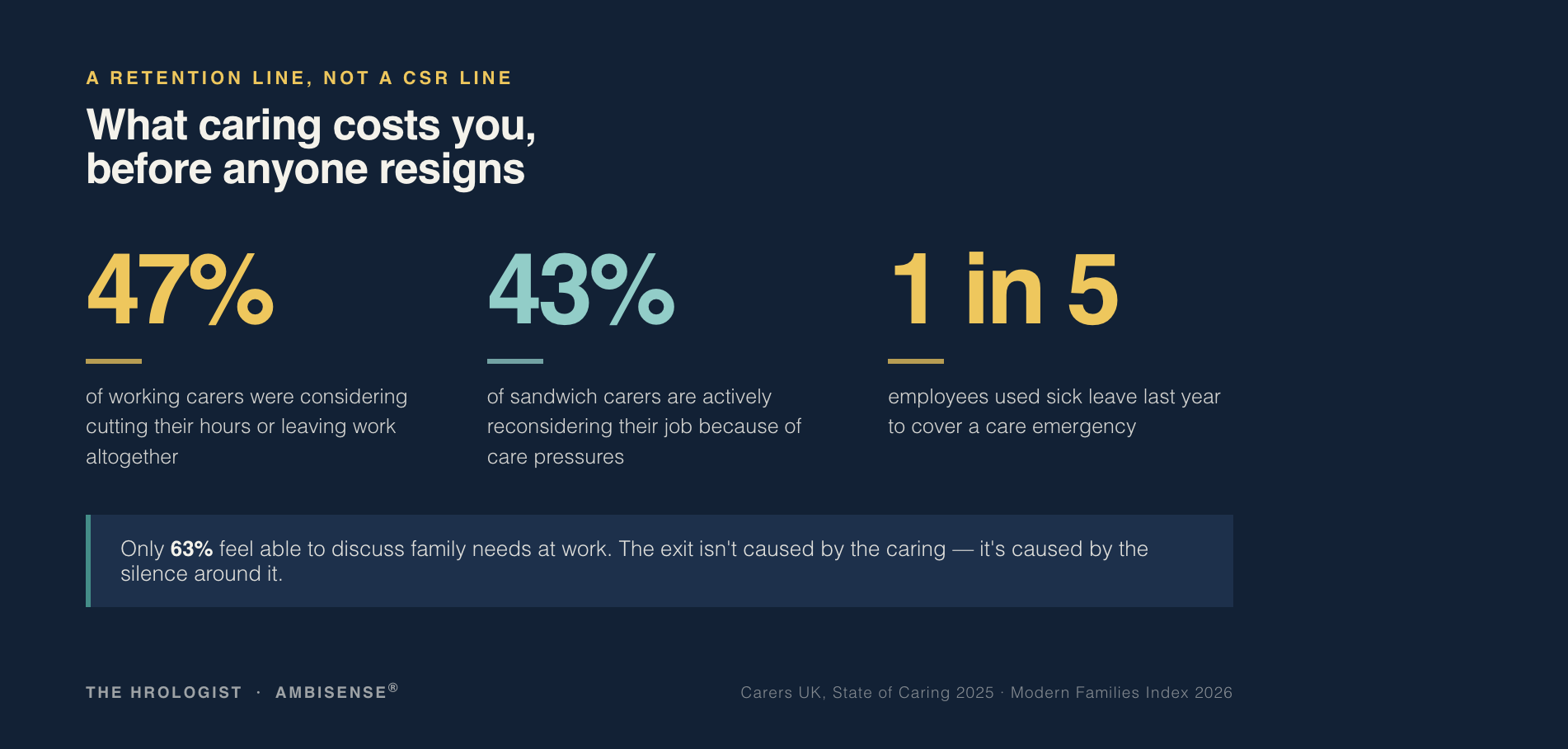
The Department for Business and Trade estimates that around three million unpaid carers are balancing work with caring, with many reducing hours, delaying a return or leaving altogether. Carers UK's State of Caring 2025 survey found that 47% of working carers were considering cutting hours or leaving work.
The Modern Families Index 2026 puts figures on what that looks like inside a business:
43% of sandwich carers are actively reconsidering their job because of care pressures
One in five employees used sick leave last year to cover a care emergency
29% of working parents report very high stress, and most of those say it sometimes stops them functioning
Only 63% feel able to discuss family needs at work
““psychological safety is operational infrastructure, not a wellbeing extra””
Read the second and fourth points together. A fifth of your people are managing a care crisis through a sickness code, because the honest conversation does not feel available. That is not an absence problem. It is a disclosure problem wearing an absence problem's clothes, and it corrupts your workforce data at the same time.
Carers UK also found that nearly half of those who had already given up work did not feel comfortable raising it with their line manager, and 43% said their employer had no carer policies in place. The exit was not caused by the caring. It was caused by the silence around it.
And the people in that sandwich-carer group, children on one side, ageing parents on the other, are usually the ones your succession plan is built around.
What schools are carrying, and where it meets your rota
Any school leader reading this already knows the next four paragraphs. They are here because the other side of the table generally doesn't.
Inclusion is moving from something a school does well to something every school is expected to evidence. That means a written plan for every child with identified SEND, training rolled out across the whole staff body, and early intervention delivered without waiting for a formal assessment. The funding attached is real, and so is the implementation work, which lands on leadership teams that are already full.
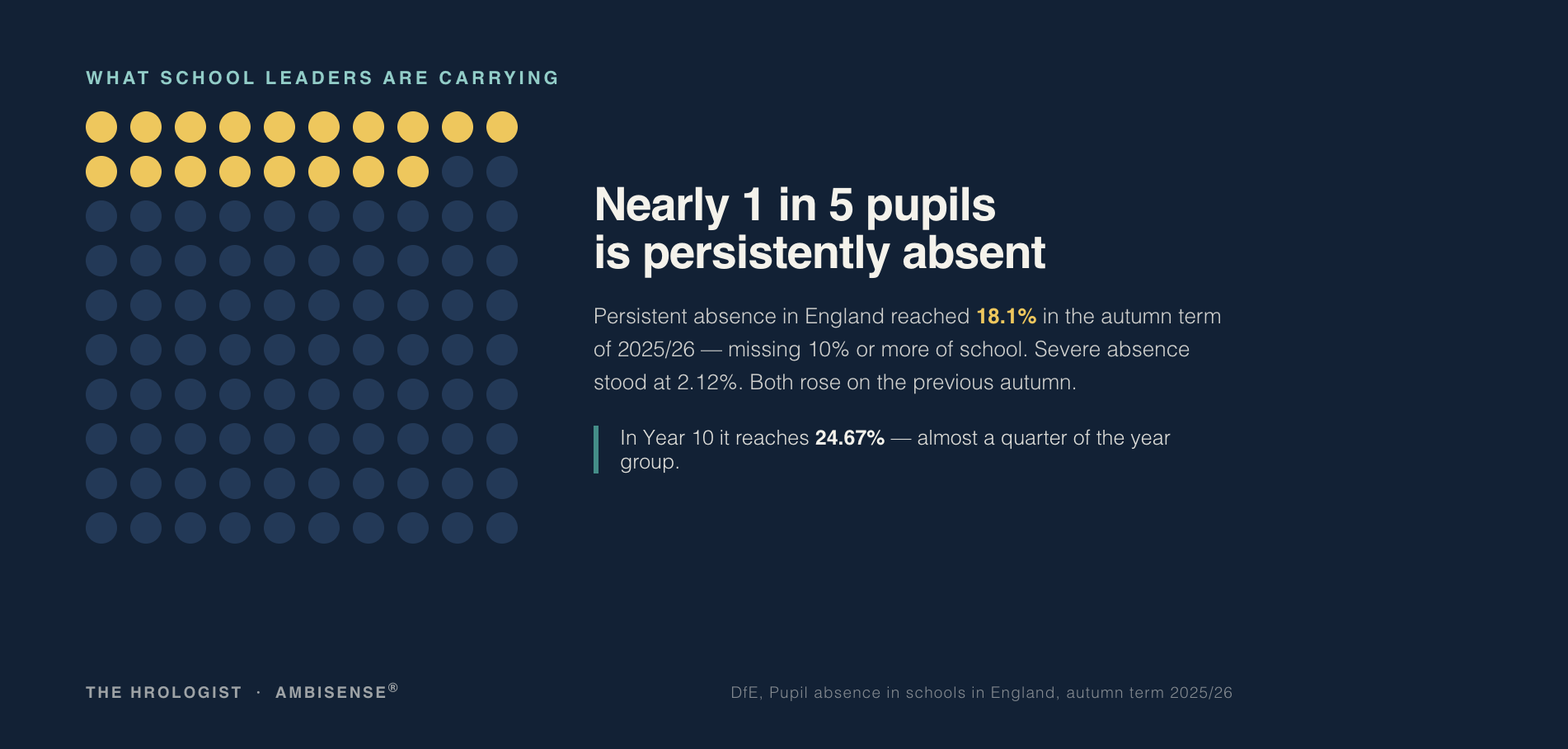
At the same time, attendance is not recovering in the way the headlines suggest. In the autumn term of 2025/26, persistent absence in England stood at 18.10% and severe absence at 2.12%, both up on the previous autumn. Persistent absence peaked in Year 10 at 24.67%.
Behind a share of those numbers sits emotionally based school avoidance, anxiety attached to the school environment that produces avoidance rather than defiance. It is slow work. It needs a trusted adult, a graduated return, and a parent who can be at the school gate at 10am on a Tuesday.
That last requirement is where the school's plan meets your rota. A school can design the perfect reintegration timetable and watch it fail because a parent cannot get the hours released and because asking for them feels like career suicide.
So the honest summary is this: schools are being asked to deliver inclusion with the cooperation of parents whose employers have not been invited into the conversation.
Five ways employers can support local schools
None of these requires a foundation, a press release, or a budget line you have to defend in January.
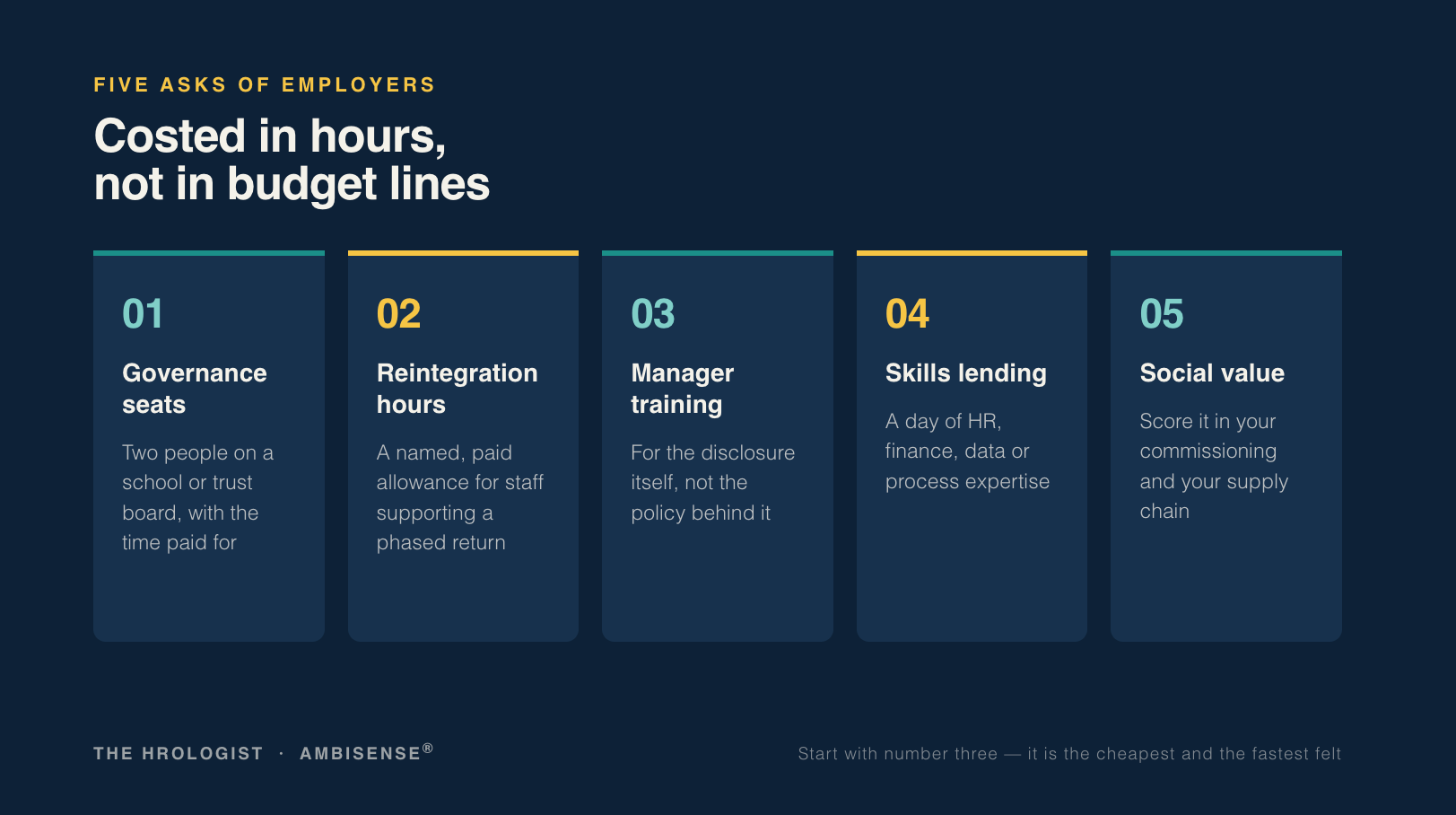
1. Put two people on a governing board, and pay for the time. Schools and trusts need governors who can read a budget, challenge a workforce plan, or understand risk. That is a description of your senior managers. Employees already have a statutory right to reasonable time off for certain public duties, school governance included, the question is whether you make it paid, visible and promotable rather than something people squeeze into annual leave. The charity Boards for Education reports that its volunteers contribute £9.9m of value to schools each year.
2. Write a reintegration clause into your flexibility policy. Not general flexible working, something narrower and more useful. A named allowance of paid hours for staff supporting a child through a phased return to school, an assessment pathway, or a new support plan. Time-bound, manager-approved, and recorded as what it is, so it stops being logged as sickness.
3. Train managers for the disclosure, not the policy. Most managers know the policy exists. Far fewer know what to say in the thirty seconds after someone says my son was excluded yesterday. That moment decides whether the employee stays. It is a skill, it is teachable, and it is nowhere in most management development programmes.
4. Lend the skills you already pay for. Multi-academy trusts run payroll, restructures, grievance cases, procurement and change programmes with a fraction of the specialist capacity you hold. A day of HR, finance, data or process-improvement expertise, offered properly rather than as a favour, is worth more to a trust than a fundraising cheque of the same cost.
5. Ask the question in your supply chain and your commissioning. If you commission services, fund community work, or run a social value framework, ask bidders what they do for working carers and for local schools. Social value scoring moves markets faster than goodwill does.
If you do one of these, make it the third. It is the cheapest and it is the one your people will feel this quarter.
Building the bridge, not another initiative
The reason these partnerships usually fail is not reluctance. It is that nobody owns the join.
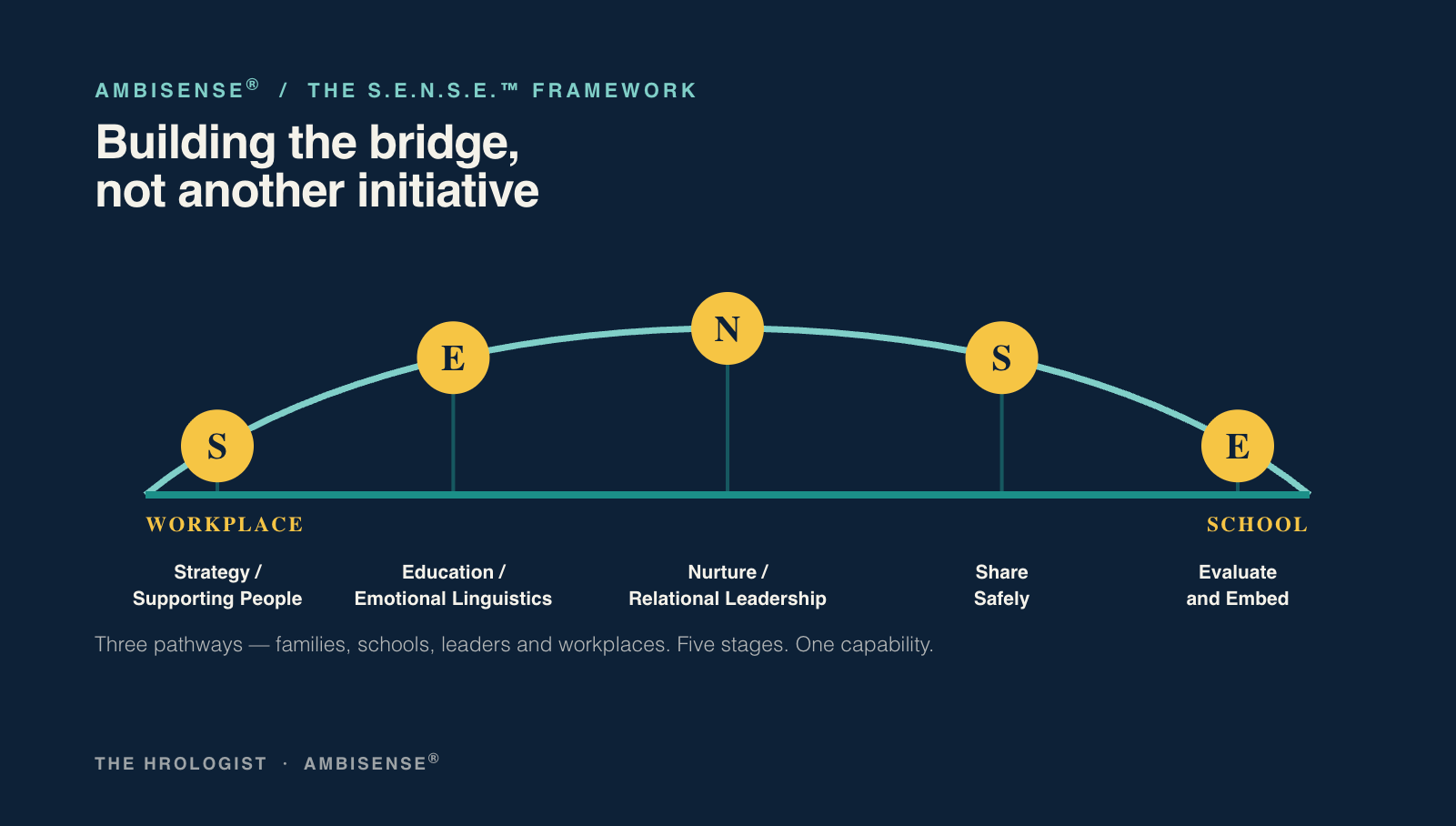
This is the work I built AmbiSense® to do. The S.E.N.S.E.™ framework runs across three pathways - families, schools, and leaders and workplaces and deliberately uses the same five stages in all three, because the capability is the same capability wherever it sits:
Strategy / Supporting People - who is actually carrying this, and what does the system currently do to them
Education / Emotional Linguistics - the language people need when the conversation is hard and the stakes are personal
Nurture / Relational Leadership - leading through relationship rather than compliance
Share Safely - the conditions that make disclosure possible, which is where most organisations lose their carers
Evaluate and Embed - measuring it properly, so it survives the next restructure
I should be straight about where this comes from. I have twenty-nine years across local government, education, social services and SMEs, a CIPD Level 7 and BPS accreditation. I am also the mother of five children with physical disability, autism, ADHD and cognitive delay between them. I have sat on both sides of that 8:40am car park, and I have written the policy that failed the person sitting in it.
The question worth sitting with
Schools are being asked to include every child. Employers are being asked to retain every carer. Neither can deliver their half alone, and the policy timetable is not going to slow down to let them find each other.
So here is the question I would put to any board, trust or leadership team this term:
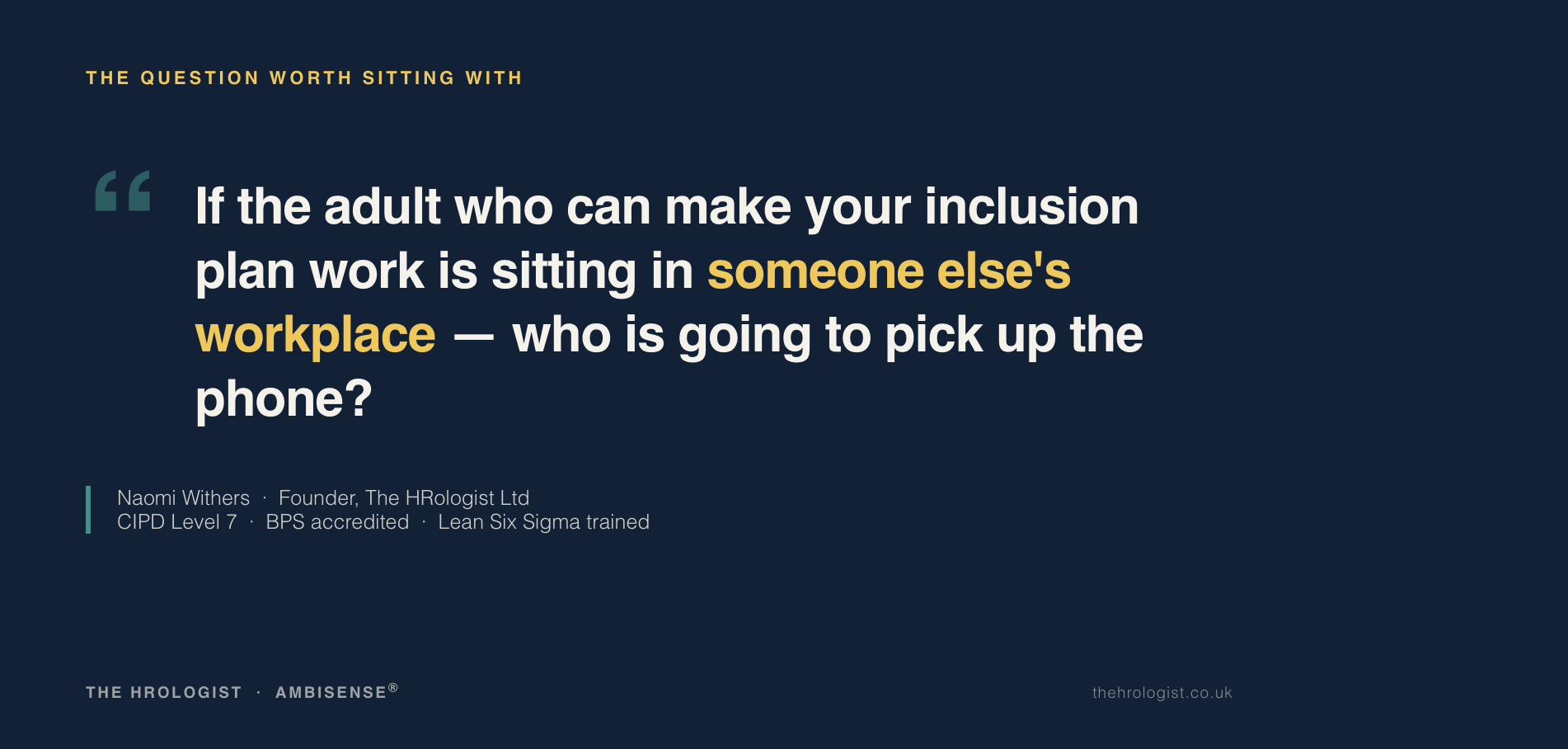
If the adult who can make your inclusion plan work is sitting in someone else's workplace, who is going to pick up the phone?
If that question lands, I would like to talk to you. I work with HR and leadership teams on carer-aware management, manager capability and emotional safety at work and with schools and multi-academy trusts on the same problem from the other end.
Book a conversation: calendly.com/thehrologist/workwithme
Connect on LinkedIn: linkedin.com/in/naomi-withers-thehrologist
Sources
The Schools White Paper 2026: SEND Reform — House of Commons Library
Schools white paper: what parents need to know about changes to the SEND system — DfE Education Hub
What school leaders need to know about the 2026 schools white paper
Employment Rights Act 2025 — Acas
What's in the Employment Rights Act — Lewis Silkin
Employment Rights Act timeline: key dates 2026–27 — DavidsonMorris
Family friendly rights: employment law reforms horizon — Osborne Clarke
Government proposes paid leave and 'right to return' for workers with caring responsibilities — People Management
Modern Families Index 2026 — Bright Horizons
Pupil absence in schools in England, autumn term 2025/26 — DfE
School governor volunteering impact — Boards for Education