

Articles on SEND, inclusion and emotional safety
Practical reading for UK parents, school leaders and employers on school anxiety, attendance, SEND, inclusion and psychological safety at work. New articles most weeks.
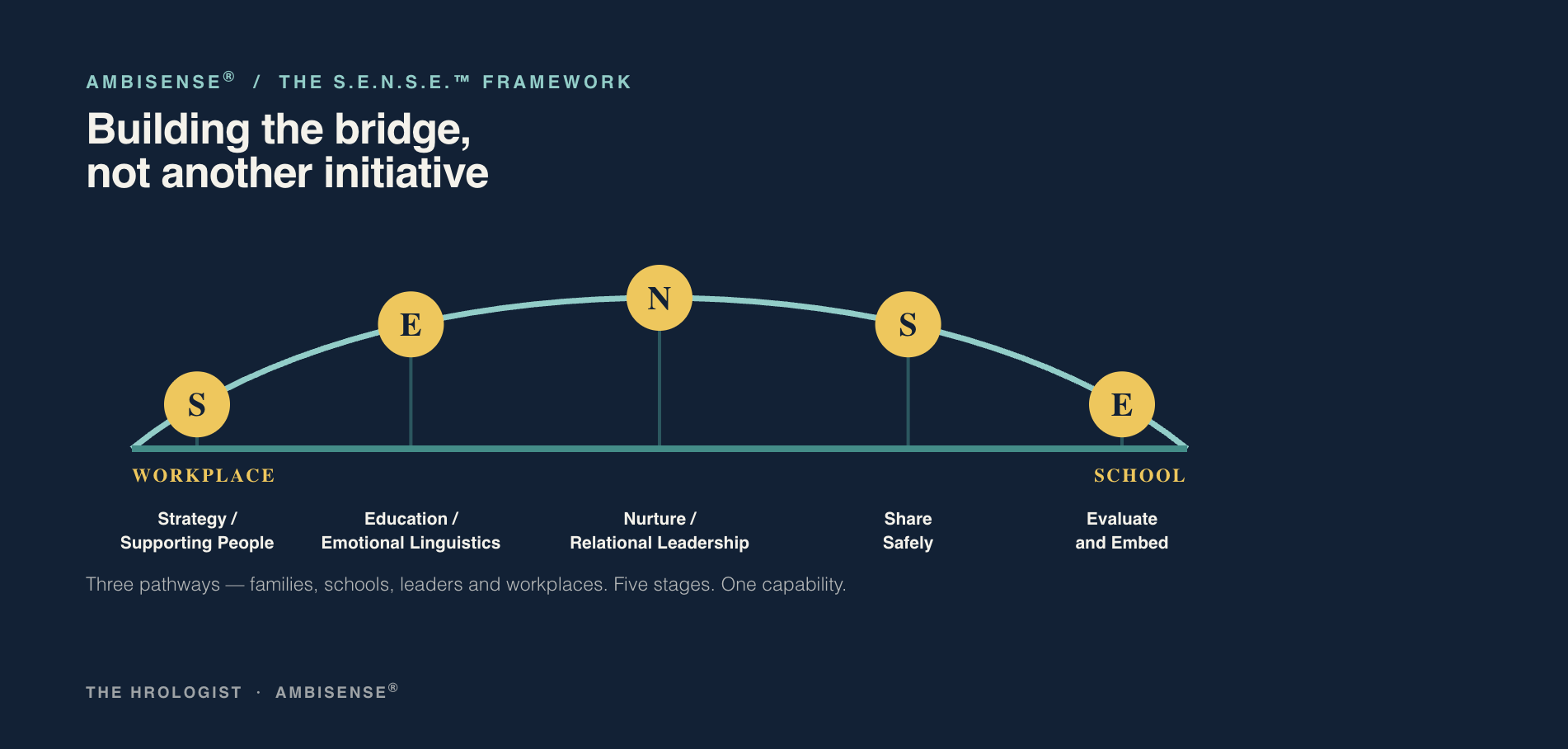

Your School's Inclusion Strategy Has a Deadline. What Happens When It Meets Real Life?
Schools must publish their inclusion strategy by 31 December 2026. But the document is only part of the picture. When the same situation keeps returning to the same people, the attendance conversation that never quite moves forward, the transition that always needs the same adult, it is telling you something a written strategy alone cannot show. Is the support working, or are committed people making it look as though it is?
Mainstream inclusion: the emotional infrastructure beneath the SEND plan
Inclusion plans fail in the gap between what a school intends and what learners and staff can reliably expect when the day goes wrong. What has to hold.

Human-Fit Leadership: We've Been Solving the Wrong Problem
Repeated pressure is rarely just a people problem. Human-fit leadership looks beyond resilience training to redesign the systems, routines and pathways that create overwhelm, repeated escalation and lost capacity, helping people function better without asking them to keep absorbing what the system fails to hold.
Found something useful? Here's your next step
Calm words for hard moments
Free de-escalation scripts for the moments that keep going wrong at home.
Get the free scriptsFind your priority pressure point
A free 20-minute leadership tool to see where pressure is building.
Get the free Pressure MapYou can also read and subscribe on Substack.
Not sure which path fits? Let's talk it through.
A short conversation about what is happening and what might help. No hard sell.
Choose your route:
™️
S
Support
Strategy & People
Assess strategic and people needs
E
Educate
Emotional Linguistic Education
Neuro-affirmed Trauma informed language
N
Nurture
Nurturing Relations
1:1 support where it’s needed most.
S
Share
Sharing Safely
Facilitated safety to share
E
Evaluate
Evaluate Progress
Monitor and evidence the impact in your setting.
AmbiSense®️ does not promise an environment without pressure.
It helps build systems that respond to pressure more predictably, humanely and effectively.