

Beyond the Resilience Trap
Restoring Operational Capacity After an Academy Trust Acquisition
Illustrative Composite Case Study: “Riverside Academy Trust” (2024–2025)
Important Notice
This is an illustrative composite scenario based on recurring patterns seen across MAT acquisition integration. “Riverside Academy Trust” is a pseudonym. Metrics, timelines and figures are demonstration-only to show the mechanism of stabilisation and should not be interpreted as audited or attributable to an identifiable trust.
Executive Summary
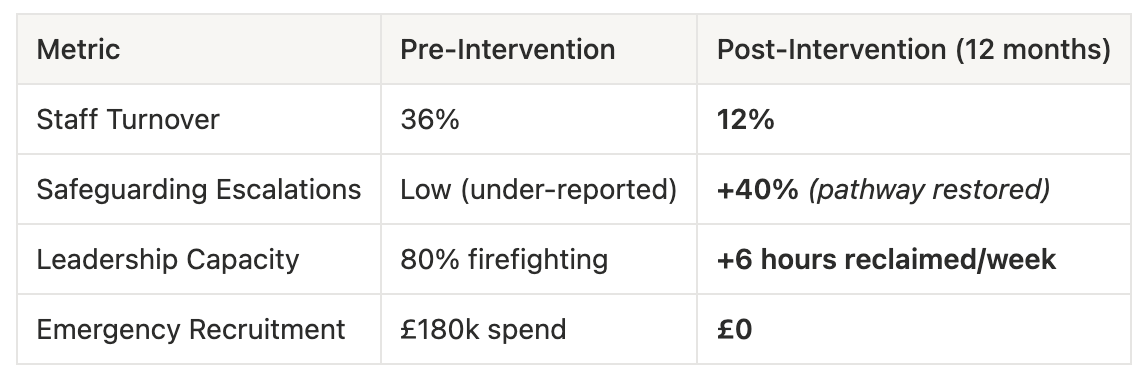
36% turnover → 12% in 12 months (illustrative).
£180k emergency recruitment spend → £0 (illustrative).
Leadership capacity reclaimed: 6 hours/week (illustrative).
Riverside did what most trusts do post-acquisition: EAP access, resilience workshops, pulse surveys, and exit interviews.
Turnover still accelerated. And a safeguarding near-miss exposed the real issue:
Risk intelligence existed, but it couldn’t travel upward safely.
Staff were flagging concerns informally (“corridor conversations”) because formal escalation felt unsafe.
Diagnosis: The issue wasn’t resilience. It was infrastructure.
So AmbiSense®️ repaired the system by installing three repeatable stabilisers:
Integration Advisors (protect institutional memory + relational equity)
Translation Protocols (Board strategy → frontline practice without accidental erosion of safeguarding)
Psychologically Safe Escalation Pathways (restore signal flow classroom → SLT → Board)
Result (illustrative): safeguarding escalations rose +40% (positive marker of trust), turnover dropped 67%, and leaders stopped firefighting long enough to lead.
Why “wellbeing initiatives” fail post-acquisition
Post-acquisition strain gets treated like a people problem.
But when the system is fractured, asking individuals to be more resilient is like asking staff to bail faster when the hull has a hole.
Resilience becomes a trap when it:
treats symptoms, not structure
asks staff to adapt to ambiguity instead of restoring clarity
incentivises silence (“don’t rock the boat”)
CEO translation: If risk intelligence can’t travel upward safely, you only learn about fires once they’re expensive.
The Diagnostic
4 structural fractures that destabilise workforce stability
1) Relational Equity Collapse
Veteran staff became “legacy obstacles.” Institutional knowledge stopped flowing.
Impact: capability leakage + accelerated exits.
2) Psychological Safety Failure
Risk signals stayed informal because escalation felt unsafe.
Impact: late safeguarding visibility + leadership blindsided.
3) Cultural Coherence Gap
Efficiency goals weren’t translated into a trauma-informed, high-needs reality.
Impact: well-intended changes created unintended safeguarding friction.
4) Agency Deficit
Change was announced, not co-built.
Impact: learned helplessness + loss of discretionary effort.
The Intervention
From lived experience → repeatable operational capacity
This wasn’t therapy. It was a structured system repair.
A Schwartz-informed diagnostic separated personality conflict from structural failure, then installed stabilisers that made safe behaviour easier.
The three stabilisers
1) Integration Advisors
A named layer to protect institutional memory and relational equity during transition.
Function: stop knowledge from walking out the door.
2) Translation Protocols
A repeatable method to translate Board intent into frontline practice.
Function: prevent “efficiency” from accidentally eroding safeguarding culture.
3) Psychologically Safe Escalation Pathways
Clear routes for risk signals to travel from classroom to SLT to Board — without social penalty.
Function: earlier intervention + fewer high-cost incidents.
Baseline layer: Ordinarily Available Support for Staff
A standard provision layer that prevents predictable strain from becoming a crisis.
Function: stabilise capacity before burnout becomes turnover.
Method: Three-phase reflective diagnostic
Individual reflection (capture real conditions)
Collective sense-making (turn informal intelligence into shared reality)
Structural translation (convert insights into Board-level decision infrastructure)
Operational Outcomes
Reminder: figures are illustrative to demonstrate mechanism and direction only.
Safeguarding culture note
The +40% rise is a positive stabilisation marker here: it suggests staff trust the pathway and escalate earlier. In high-needs environments, low reporting can indicate suppression, not low need.
What changed
Before: signals stayed informal → surfaced late → firefighting consumed leaders → burnout + exits
After: safe escalation restored → earlier intervention → fewer high-cost incidents → capacity returned → retention stabilised
Psychological safety is the mechanism by which risk intelligence reaches the Board. — Naomi Withers, AmbiSense
Who this helps
Best fit for trusts experiencing:
post-acquisition integration strain (MAT acquisition integration)
workforce instability: rising absence, turnover, recruitment costs
Safeguarding concerns surfacing late
inconsistent practice at pinch points (arrival, transitions, re-entry)
leadership overload + initiative fatigue
If safeguarding is “quiet” post-acquisition but behaviour incidents are rising, you don’t have low risk, you have blocked signal flow.
Book a 15-minute Capacity Risk Audit (we map where signals get stuck: arrivals/transitions/incidents/re-entry)
Comment/DM keyword: RIVERSIDE
FAQ
Is this a real trust case study?
No. It’s an illustrative composite scenario using a pseudonym to demonstrate the mechanism of stabilisation.
Why would safeguarding escalations increase after improvement?
Under-reporting can reflect a suppressed culture, a rise can indicate restored trust and earlier escalation.
What is “Ordinarily Available Support for Staff”?
A baseline workforce provision layer that prevents predictable overload from becoming a crisis, stabilising operational capacity, retention, and consistency.
This case study is for informational purposes and does not constitute formal HR, safeguarding, or legal advice. Every trust's context is unique; outcomes will vary based on your specific circumstances, existing infrastructure, and implementation approach. Illustrative metrics shown reflect the mechanism and direction of travel observed in composite scenarios. Actual outcomes depend on organisational context, baseline conditions, leadership commitment, and implementation fidelity. Past patterns do not guarantee future results.
All case materials are anonymised composites drawn from patterns across multiple settings. No individual, trust, staff member, or child is identifiable. This approach protects confidentiality while demonstrating repeatable mechanisms
