

Phone Ban in Schools: Why Behaviour Won’t Shift Until We Rebuild Regulation (A Trust Playbook)
There’s a moment most school staff can picture without me even trying to describe it.
Gate duty. A student arrives already sharp and spiky around the edges. You watch them hand over the phone, shove it into a locker, and walk in… but you can feel the dysregulation didn’t leave with the device.
I know that moment from both sides. I’ve been the HR lead, sitting with exhausted staff who feel like they spend more time policing than teaching. I’m also a mum, trying to close a screen at home, watching my child react like I’ve pulled the floor out from under them.
So when I say this, I mean it with care:
Removing the phone removes the object; it does not rebuild the skill.
In one sentence (for leaders): a phone ban removes the device, but behaviour won’t reliably shift unless schools rebuild regulation skills, especially at transitions like arrival, corridors and lesson changeovers.
What “phone-free by default” means and what Ofsted will expect
DfE guidance is now clear: schools should be mobile phone-free by default (exceptions only).
Ofsted has also set out how they’ll view this in inspection. If a school has completely banned phones, inspectors will expect to see:
The policy is communicated clearly
The environment is phone-free during inspection
Breaches are dealt with consistently
Government comms have reinforced that Ofsted will examine both the policy and how effectively it’s implemented when judging behaviour.
Here’s the line I want every SLT and MAT CEO to hold:
Policy is the fence. Regulation is the bridge.
Why behaviour often spikes when phones are removed
Phones aren’t “just phones” anymore. For a lot of young people, they’ve become:
an attention anchor
an avoidance exit
a dopamine stabiliser
a social safety blanket
So when you remove them, some students don’t simply “get used to it”. They wobble, and that wobble shows up as:
threshold arguments
corridor escalation
refusals and power struggles
Staff burnout through constant enforcement

If the only tool we offer is sanction, your staff become the shock absorbers for dysregulation.
That isn’t a behaviour strategy.
It’s a workload crisis.
Pouches vs lockers vs hand-in: what works (and what fails)
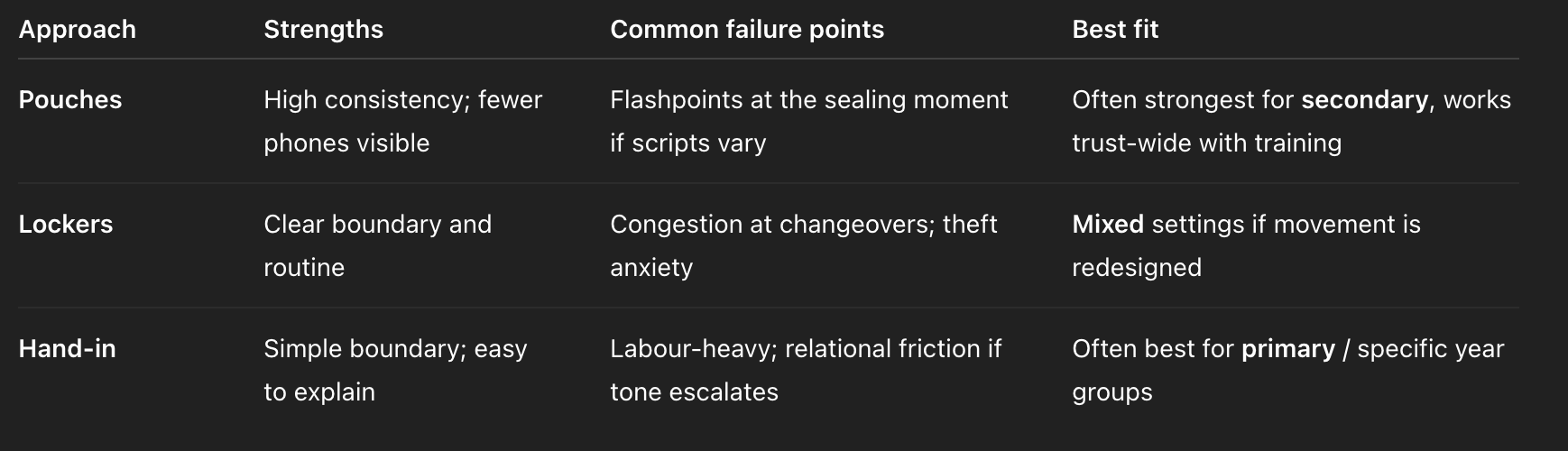
Here’s the truth: whichever method you choose, success comes down to two levers:
Consistency of adult response
Transition design (because that’s where behaviour breaks)
Enforcement without escalation: the staff-script system
The fastest way to reduce conflict is to remove improvisation.
Pick one shared phrase used by every adult:
“We’re protecting attention here.”
Then add a calm, predictable choice (not a debate):
“You can hand it in now, or we’ll walk together and do it calmly. Either way, you’re safe.”
This shifts staff from “phone police” to attention safeguarding, and it reduces heat instantly because the student isn’t trying to decode ten different adult styles.
Transitions are the battleground: arrival, corridors, changeovers
Behaviour pain peaks at thresholds because that’s where nervous systems wobble.
So don’t just ban phones. Build landing routines.
The 30-second landing zone (non-negotiable)
feet on the floor
one visual instruction
one task
a short, silent start (or movement start) before heavy demands begin
Micro-boredom: rebuilding the “waiting muscle” (90 seconds)
During equipment handout or settling time:
“We’re doing a waiting moment. It feels itchy — that’s okay. Feet on the floor. Let the brain land.”
Frustration tolerance is a skill. Skills are trained, not demanded.
SEND and reasonable adjustments in a phone-free school
Phone-free by default doesn’t mean identical for everyone.
It means:
a clear baseline expectation
explicit exceptions (by need, not negotiation)
alternatives that preserve dignity and consistency
A simple pathway stops the whole thing from collapsing under pressure:
communication needs (AAC/translation / medical monitoring)
accessibility adjustments (documented, agreed, predictable)
sensory regulation tools that aren’t phones (so you don’t replace one trigger with another)
Goal: inclusion strengthens - consistency doesn’t collapse.
Trust-wide rollout plan: the 30–60–90 day playbook (for mixed trusts)
If you want this to work across a trust, standardise what must be standardised.
The 3 layers of trust consistency
Language (one shared script)
Threshold routine (landing zone)
Breach response (calm, predictable, consistent)

30 days
comms pack to parents/students
staff script sheet (DO/SAY)
landing zone routine (every classroom, every day)
60 days
threshold audit (arrival/corridor/changeover hotspots)
corridor pinch-point redesign
SEND adjustment pathway agreed and communicated
90 days
consistency coaching (what “good” looks like)
data review + refine by phase (primary/secondary)
reduce staff workload by removing repeated conflict loops
Track 5 metrics for 6 weeks
corridor incidents
threshold refusals
lesson starts (time-to-settle)
staff confidence using scripts
repeat breaches (same students, same moments)
That’s how you know whether you changed behaviour… or just moved it around the building.

FAQs
Will Ofsted check our mobile phone policy?
Ofsted has said that where a school has banned phones, inspectors will expect clear communication, a phone-free environment during inspection, and consistent handling of breaches.
Do phone bans improve behaviour in schools?
They can reduce distraction. Sustained behaviour change comes when you pair the ban with regulation infrastructure: scripts, landing routines and transition design.
Why does behaviour sometimes get worse at first?
Because removing the phone removes an emotional stabiliser. Without a bridge, nervous systems wobble at thresholds, and conflict fills the gap.
What’s best: pouches, lockers or hand-in?
The best option is the one you can implement most consistently with the fewest pinch points — supported by aligned scripts and calm breach responses.
What about SEND students who need devices?
Build a clear adjustment pathway for communication, medical or accessibility needs and provide predictable alternatives. The goal is consistency with dignity.
Next step
If you’re implementing (or re-implementing) phone-free and want the “Monday-ready” version, I can share:
a 1-page Phone-Free Bridge Checklist (5 high-risk moments + DO/SAY scripts)
a trust-wide Transition Load Audit so you can standardise consistency without increasing staff workload
