

Calm, clear change that starts with the conditions around people
The HRologist helps schools, families and workplaces understand what is really driving pressure, then put simple, repeatable habits in place to ease it. Our work draws on four established bodies of knowledge. We name each one below, with its source, so you can see exactly where our thinking comes from.
The visible issue is rarely the whole issue
Looking at the system, not just the moment.
A meltdown at the school gate, a staffroom that has gone quiet, a team that has stopped raising problems. These are what people see. Underneath there is usually something structural: unclear expectations, communication gaps, or too much pressure arriving at the same point. We start there, because it is rarely a people problem.
What our approach is grounded in
Why do good people struggle in some places and thrive in others?
Organisational psychology studies how roles, structures, leadership and culture shape the way people think, feel and behave at work. We use it to look past individual blame and find the friction in the system itself.
Source: the field as described by the British Psychological Society's Division of Occupational Psychology.
Can people speak up here without fear?
Professor Amy Edmondson of Harvard Business School defines psychological safety as a shared belief that a team is safe for interpersonal risk-taking. When it is present, people ask for help, admit mistakes and raise concerns early, which is when problems are easiest to fix.
Source: Edmondson, A. (1999), Psychological Safety and Learning Behavior in Work Teams, Administrative Science Quarterly.
Can we notice, name and manage what we feel?
Emotional intelligence is the ability to recognise and understand emotions in ourselves and others, and to use that understanding to guide how we respond. We treat it as a set of skills adults and young people can practise, not a fixed trait.
Source: Salovey, P. & Mayer, J. D. (1990), Emotional Intelligence; popularised by Daniel Goleman (1995).
Where do staff get to process the emotional side of the job?
Our reflective practice is informed by the principles of Schwartz Rounds®, a structured forum where colleagues from across an organisation share the emotional and social impact of their work. An NIHR-funded evaluation (Maben et al., 2018) found that staff who attended regularly reported lower psychological distress.
Source: Schwartz Rounds® were developed by The Schwartz Center for Compassionate Healthcare and are licensed in the UK by the Point of Care Foundation.
How it comes together: the AmbiSense® framework
AmbiSense® is our non-clinical emotional safety framework. It turns the ideas above into five practical stages.
- SupportSteady the immediate pressure so people can think clearly again.
- EducateShare plain-English language for what is happening, for staff, parents and young people.
- NurtureBuild small, repeatable habits that make it safer to speak up.
- ShareCreate regular, structured space to reflect together.
- EvaluateAgree with you at the start what "better" looks like, then check it honestly.
Where to start
Schools and MATs
Start with a School Pressure Map: a diagnostic look at where structural friction and communication gaps are building. Then choose a 30-Day Calm Bridge™ Install or a 90-Day Embed & Scale programme.
Explore the schools pathwayParents and families
Practical scripts and guidance for school anxiety, meltdowns and high-demand moments at home.
Explore the families pathwayWorkplaces
Psychological safety and emotionally intelligent leadership habits for teams under strain.
Explore the workplaces pathwayWhat we are, and what we are not
We are
- Psychology-informed and grounded in published research, which we name.
- Non-clinical and safeguarding-aware.
- Practical: everything we introduce is designed to be repeated by your own people after we leave.
- Clear about measurement: we agree what we will check at the start and report it back plainly.
We are not
- Therapy, counselling or diagnosis. We work alongside mental health, SEND and safeguarding professionals, never instead of them.
- A quick fix. Culture changes through habits, and habits take time.
- Affiliated with, or accredited by, any other named programme or approach unless we say so on this page.

Who is behind the work
I'm Naomi Withers, founder of The HRologist. I hold a BPS-accredited qualification in psychology, with over 10 years' experience applying it, and a postgraduate qualification in strategic human resource management. I've spent more than 25 years working with families, schools and organisations, and I'm a mum of five, so I know school pressure from both sides of the gate. I built AmbiSense® because I kept seeing capable people and caring families blamed for problems the system had created.
Startup Awards Midlands finalist, 2025 and 2026
Frequently asked questions
Is AmbiSense® therapy?
No. AmbiSense® is a non-clinical framework. It helps adults create calmer, clearer conditions and build emotional skills. If someone needs clinical or specialist support, we will say so and signpost appropriately.
What does psychological safety mean in a school?
It means staff, pupils and parents believe they can ask questions, raise concerns or admit mistakes without being embarrassed or punished. The term comes from Professor Amy Edmondson's research on teams. In schools it shows up in how meetings run, how concerns are received and how leaders respond to bad news.
Do you run Schwartz Rounds®?
Not as Schwartz Rounds®, which are a licensed programme run in the UK through the Point of Care Foundation. Our reflective sessions are informed by the same principles: structured, confidential space for staff to talk about the emotional side of their work.
What evidence is your approach based on?
We draw on organisational psychology, Amy Edmondson's research on psychological safety, Salovey and Mayer's model of emotional intelligence, and published evaluations of Schwartz Rounds®. We name our sources so you can read them yourself. We do not claim that any single programme guarantees a particular result.
Who do you work with?
Primary and secondary schools, multi-academy trusts, local authority commissioners, parents and carers, and workplaces including founders and growing teams across the UK.
How do we get started?
Book a short call. For schools, the usual first step is a School Pressure Map. For families, our free de-escalation scripts are a good place to begin.
How will we know if it is working?
In the Evaluate stage we agree with you at the start what we will measure, then review it together and report back plainly.
Ready to see where the pressure is building?
Start with a conversation. No hard sell, just a clear picture of what is going on and what might help.
™️
S
Support
Strategy & People
Assess strategic and people needs
E
Educate
Emotional Linguistic Education
Neuro-affirmed Trauma informed language
N
Nurture
Nurturing Relations
1:1 support where it’s needed most.
S
Share
Sharing Safely
Facilitated safety to share
E
Evaluate
Evaluate Progress
Monitor and evidence the impact in your setting.
AmbiSense®️ does not promise an environment without pressure.
It helps build systems that respond to pressure more predictably, humanely and effectively.
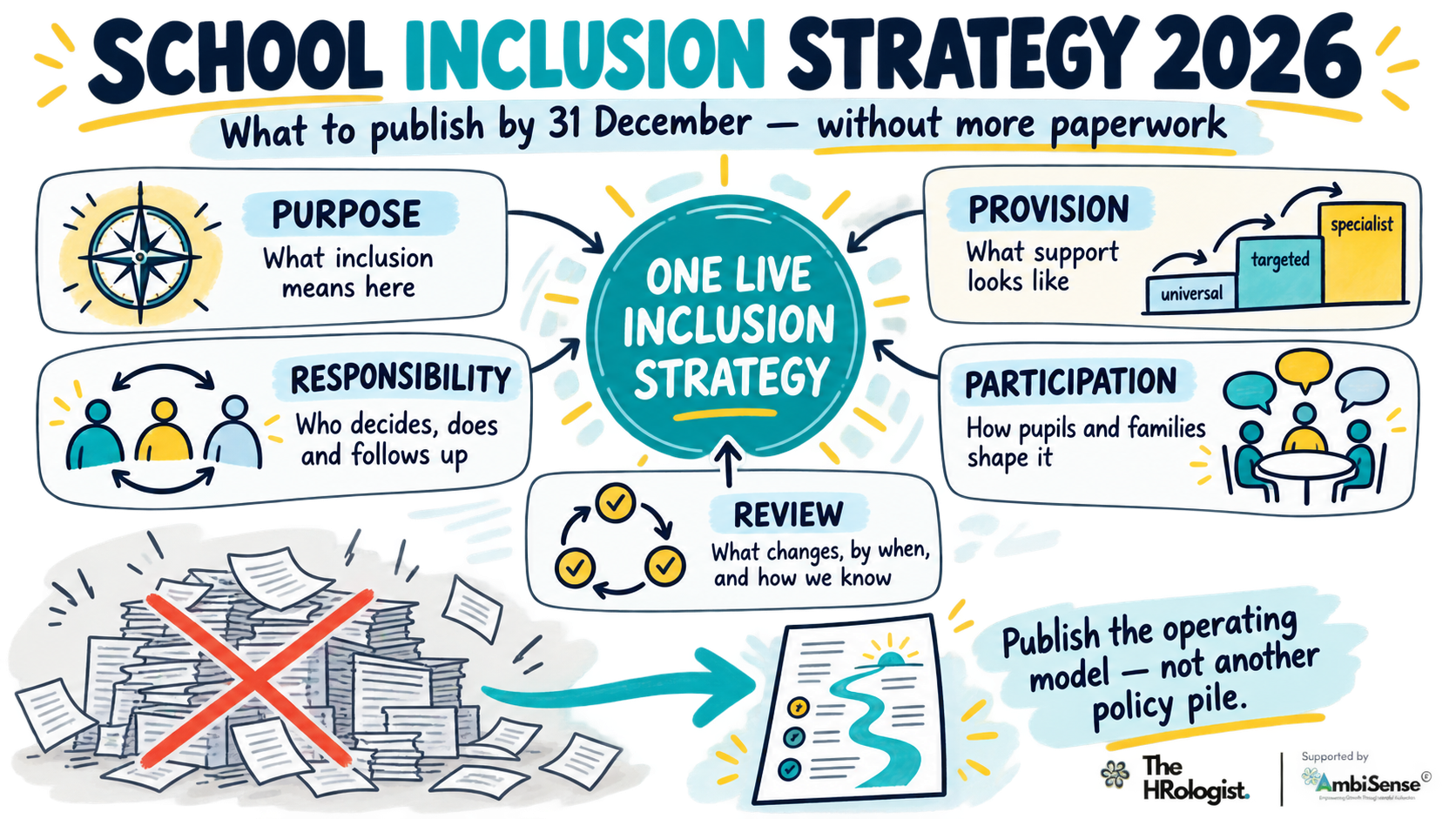
Schools must publish their inclusion strategy by 31 December 2026. But the document is only part of the picture. When the same situation keeps returning to the same people, the attendance conversation that never quite moves forward, the transition that always needs the same adult, it is telling you something a written strategy alone cannot show. Is the support working, or are committed people making it look as though it is?