

School Inclusion Strategy 2026: What to Publish by 31 December - Without More Paperwork
For mainstream schools and academies in England: your 2026–27 inclusion strategy statement must be published on your school website by 31 December 2026. The document must identify barriers to learning and participation, explain the activities being funded to address them, and show the budgeted costs.[1]
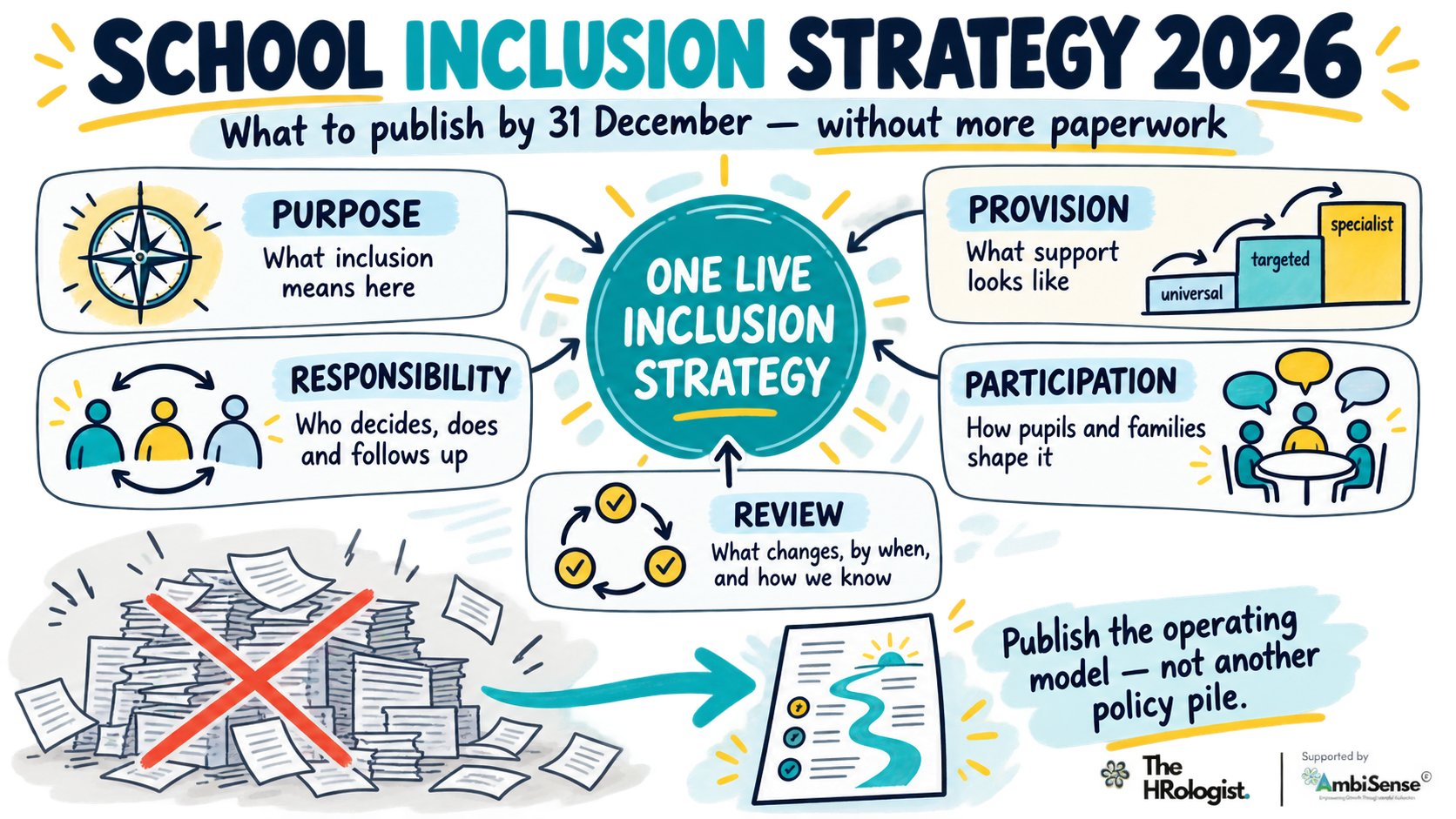
The school inclusion strategy deadline for 2026 is clear. By 31 December, mainstream schools and academies in England must publish a strategy showing how they will use the Inclusive Mainstream Fund (IMF) to remove barriers to learning and participation.[1]
The document is the easy bit. The harder question is whether any of it changes what actually happens when Monday morning is difficult.
A well-worded strategy might satisfy the publication requirement. It will not, on its own, make the transition from lunch to afternoon lessons go smoothly, stop the same escalation eating into three members of staff's time, or give a parent and teacher one clear account of what happens next.
That is the practical test of a SEND inclusion strategy: can staff actually use it when things get messy?
What must a school's 2026 inclusion strategy include?
Schools must identify commonly occurring barriers to learning and participation, explain the activities funded to address them, state the intended outcomes and budgeted costs, and review previous activity where applicable. Each individual school must publish its own statement by 31 December 2026.[1]
What must schools publish by 31 December 2026?
The Inclusive Mainstream Fund (IMF) is additional funding to help mainstream schools strengthen inclusive provision and remove commonly occurring barriers to learning and participation. It sits alongside core funding - including the notional SEN budget - not instead of it.[1]
Every individual school must publish an inclusion strategy statement for the 2026–27 academic year by 31 December 2026. That applies even where a multi-academy trust pools IMF resources - each academy still needs its own published strategy.[1]
The strategy must cover:
the commonly occurring barriers to learning and participation identified across the school's cohort;
the activities being funded to alleviate those barriers;
the intended outcomes;
budgeted costs; and
a review of the previous academic year, where applicable.[2]
Schools must also keep clear records of IMF income, expenditure and evidence of how the funding was used. Governors and trustees are expected to scrutinise the strategy, spending plans and outcomes. The DfE will review a sample of published statements, and your inclusion strategy will be available to Ofsted inspectors when they evaluate inclusion.[1]
This is not a website-upload exercise. Leaders need a credible line from identified barrier to funded action to implementation to evidence of change.
Why does inclusion strategy implementation matter now?
More than one in five pupils in England has identified SEN. In 2026, 6.0% of pupils had an EHC plan and 14.8% received SEN Support - approximately 1.86 million pupils altogether. The number with an EHC plan increased by 11.6% between 2025 and 2026, and 57.8% of pupils with EHC plans were educated in state-funded mainstream primary and secondary schools.[1]
The IMF provides £400 million per year over the three-year spending period. At that scale, the implementation question cannot be ducked: can schools show not only where the money went, but what actually became more inclusive in daily practice?[2]
National figures do not tell any individual school what its barriers are. They show why leaders must look carefully at their own cohort, listen to pupils, families and staff, and connect funding decisions to things that are observable - participation, belonging, access to learning.
What are the DfE's seven principles of inclusion?
Any activity funded through the IMF must align with at least one of the DfE's seven principles:
Ambitious leadership and governance that embeds inclusion.
Evidence-based support prioritising early intervention.
High-quality adaptive teaching with curriculum designed for all learners.
Enriching provision beyond the classroom that all children can access.
A safe and respectful culture fostering belonging, attendance and participation in learning.
Strong partnerships with families and wider services.
Inclusive environments with continuous improvements to accessibility.[2]
The DfE does not expect schools to spread their allocation thinly across every principle. The guidance is clear: focus on a small number of impactful, evidence-informed activities and implement them properly.[2]
The updated best-practice guidance also emphasises understanding your cohort, strengthening the universal offer and addressing commonly occurring, predictable barriers before needs escalate. Targeted support comes in when the universal offer is not enough - implemented carefully and evaluated for impact. IMF funding may support staff development, specialist input, implementation, evaluation and data collection where these meet the grant conditions.[1]
That matters, because under pressure the temptation is to build a long list that looks comprehensive. But breadth on paper becomes inconsistency in practice.
The risk is not just missing information in the published document. It is funding activity that reads well but produces no consistent response when the pressure rises. The operational cost of that is real: repeated leadership escalation, lost SENCO and pastoral capacity, avoidable recording and recovery time, inconsistent messages home, reduced staff confidence, and activity that cannot be evidenced when someone asks.
What will Ofsted consider from September 2026?
Ofsted's updated state-funded school inspection toolkit applies from 7 September 2026. Within the inclusion evaluation area, the expected standard explicitly refers to leaders, governors and trustees developing and publishing an inclusion strategy that explains how the school's overall funding - including the IMF - will meet the specific needs of its cohort and improve inclusive practice.[2]
Inspectors will consider what leaders are trying to achieve, how effectively they are delivering it, and how they know it is working. They will pay particular attention to the experiences and outcomes of pupils with SEND, disadvantaged pupils, pupils known or previously known to children's social care, and others facing barriers to learning or wellbeing. The SENCO and other inclusion leaders may be directly engaged.[3]
Ofsted's focus is on the quality and impact of leaders' choices, not a separate bundle of inspection paperwork. Schools are not expected to prepare written evidence for every toolkit standard or complete a formal self-evaluation solely for inspection - but leaders do need to explain their priorities, their actions, and how they have assessed impact.[3]
For inclusion strategy work, there is a clear line of sight:
specific cohort need → leadership decision → funded activity → change in practice → impact understood.
Governors and trustees add value here. Their role is not to sign off the published statement and move on - it is to test whether the chosen actions actually address the identified barriers, whether the implementation is realistic, and what evidence will show that pupils' access, participation, belonging or outcomes are improving.
Why can an inclusion strategy fail in daily practice?
Here is a situation most schools will recognise.
A pupil becomes overwhelmed during the move from lunch to afternoon lessons. One adult gives space. Another repeats the instruction. A third calls pastoral support. The SENCO gets pulled in. Home receives two different explanations. Everyone is genuinely trying to help - but the pathway changes depending on who is standing there.
The visible incident gets recorded as behaviour. The operational problem started earlier:
Where did the first signs appear?
What changed in the environment or the demand?
Did staff recognise the same cues?
Was there an agreed first response?
Who owned the next step?
What happened when the usual trusted adult was unavailable?
That is where inclusion becomes real. It is not about whether the policy uses the right language. It is about whether adults have a response they can actually carry on a hard day.
The DfE's guidance supports this exactly. It asks schools to treat implementation as a process, not an event: engage staff and families, plan realistic delivery, monitor data and feedback, protect staff workload, and evaluate whether barriers are genuinely being alleviated.[2]
What could this look like in practice?
This is an illustrative example, not a client case study.
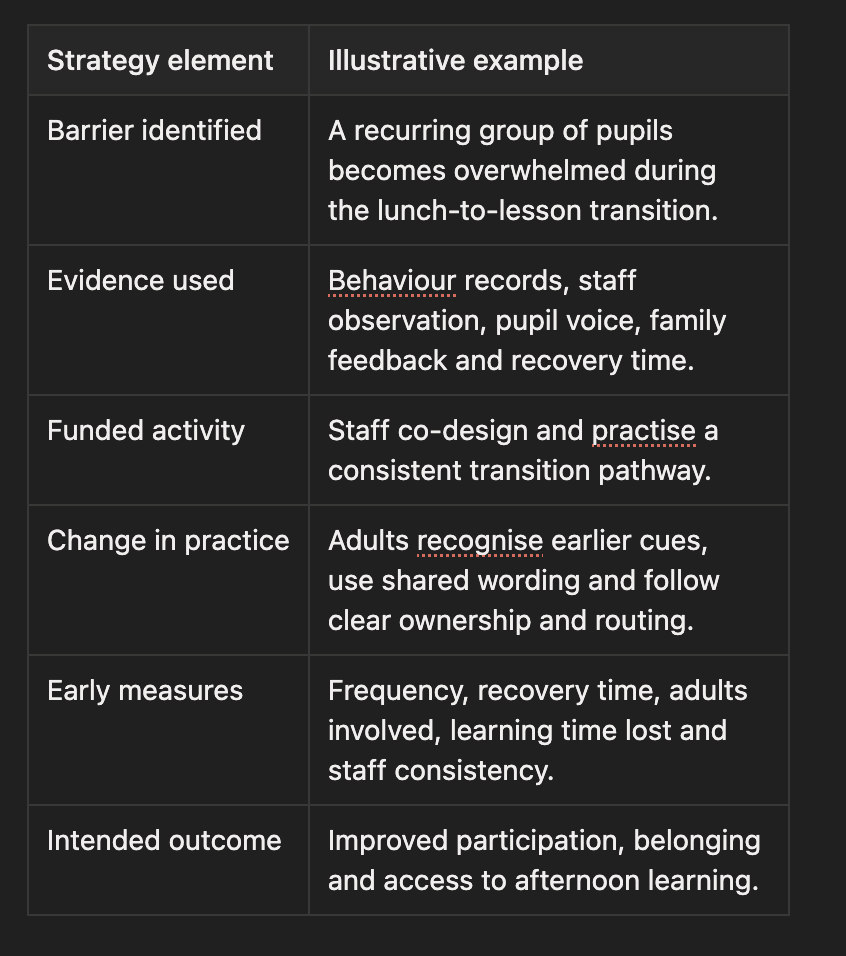
The table creates a visible line - from the barrier pupils are experiencing, to the activity funded, to the adult practice expected, to the evidence that will be reviewed.
What does psychological research add?
Belonging is not a soft extra
A systematic review of 86 studies found that school belonging is connected with pupils' academic, behavioural and psychological outcomes. The pupil–teacher relationship was the strongest predictor at the immediate relational level, while positive classroom climate and school support practices were among the strongest school-level predictors.[1]
Belonging is not created by a statement on a website. Pupils build it through repeated interactions - whether adults notice, whether responses feel predictable, whether support protects their dignity, and whether they can get back into learning after a hard moment.
💡 Belonging is not what a school says pupils should feel. It is what repeated school experiences teach them to expect.
Capacity can change under pressure
A meta-analysis covering 55 studies and 8,070 children and young people found that trauma exposure was associated with lower performance in working memory, inhibition and cognitive flexibility. The authors reported small-to-medium effects and were clear that the findings should not be used as a simple measure of everyday impairment.[2]
I want to be careful about how this is used. It should not be used to diagnose a pupil, excuse harmful behaviour, or assume that every difficult moment has a trauma explanation. What it does challenge is a common mistake: interpreting reduced capacity under pressure as a straightforward refusal to comply. For some pupils, the moment adults are demanding more remembering, more inhibition, or rapid switching between tasks may be the moment those capacities are hardest to access.
The practical response is not lower expectations. It is making the route to meeting expectations clearer - reduce unnecessary ambiguity, use calm and consistent first-response wording, restore enough safety for thinking, and teach or practise the missing skill.
Training is not the same as implementation
A 10-year review of implementation science in school mental health describes a persistent gap between knowing what may work and what is consistently delivered in schools. It highlights implementation factors including usability, intervention complexity, staff stress and workload, leadership support, training, coaching, data, feedback and shared ownership.[3]
This is why another policy, another resource, or another training day may not change the repeated moment. People need a pathway that fits their setting, clear ownership, a chance to practise, and feedback showing whether the response is being used - and whether it is helping.
The psychological case is practical: protect belonging, design for capacity under pressure, and treat implementation as something that must be made genuinely usable - not an instruction people are expected to remember when the system runs hot.
How can schools evidence inclusion strategy implementation?
A useful inclusion strategy should allow a governor, inspector, parent or member of staff to follow four connected stages.
1. Noticed
Name the repeated barrier precisely.
"Improve inclusion" is too broad. "Reduce behaviour incidents" describes an outcome but hides the pressure point. A stronger starting point is a recognisable moment:
Year 7 arrivals repeatedly break down after difficult mornings.
The lunch-to-lesson transition creates overwhelm for a recurring group of pupils.
Parent-school communication escalates when attendance starts to fall.
Pupils returning after absence do not have a consistent reintegration route.
One trusted adult is carrying most of the recovery work.
Use attendance, behaviour and attainment data - but do not stop there. The DfE recommends classroom observation, staff insight, engagement with pupils and families, discussions with external professionals, and evidence about local or national changes in need.[2]
2. Decided
Explain why this barrier has been prioritised and why the chosen activity is a credible response.
The decision should connect the school's context, the available evidence and the relevant inclusion principle. It should also be honest about scope. One well-chosen pressure point with clear ownership and measures is more defensible than ten loosely connected activities.
Ask:
What barrier are we trying to reduce?
Which pupils are affected - without waiting for a diagnosis alone?
What evidence supports this approach?
What will staff need to do differently?
Who has the time, authority, information and cover to own it?
If we add this, what are we taking away?
3. Changed
Describe what will actually be different in daily practice.
Training delivered is an input. A resource purchased is an input. A new post or provision is an input. The strategy should go further and show the operational change those inputs are meant to create.
For example:
staff use shared first-response wording at the point of difficulty;
a transition routine is adjusted before overwhelm peaks;
routing is clear when additional support is needed;
family communication follows one agreed process;
responsibility no longer defaults to the SENCO or one pastoral lead;
the response still works when the usual trusted adult is absent.
This is the bridge between funding and what pupils actually experience.
4. Tracked
Choose a small set of measures that show whether implementation is holding and whether the situation is becoming more workable.
Depending on the pressure point, early indicators might include:
frequency of the repeated situation;
time spent responding and recovering;
number and seniority of adults drawn in;
time away from learning;
use of the agreed route or script;
repeat contact with home;
attendance or participation at the affected point of the day;
staff confidence and consistency;
what pupils and families notice;
whether pressure has reduced - or just moved somewhere else.
The DfE identifies attendance, attainment, progress in learning, belonging, wellbeing, participation, engagement and behaviour as relevant pupil outcomes. Evaluation should be ongoing, based on realistic short-, medium- and long-term goals.[2]
Not every improvement is an immediate cash saving. Be clear about the difference between actual cashable savings, reclaimed staff capacity, improved consistency and reduced operational risk. Record your baseline before promising an outcome.
School inclusion strategy 2026 checklist
Before publication, leaders and governors should be able to answer yes to the following:
[ ] We have identified commonly occurring barriers across our pupil cohort using observation, staff and family insight, attendance, behaviour, participation and attainment - not only existing diagnoses, SEN Support or EHC plans.
[ ] Our chosen activities align with one or more of the seven principles of inclusion.
[ ] We can explain the evidence and local insight behind each choice.
[ ] The strategy shows budgeted costs and how IMF funding works alongside core funding and the notional SEN budget.
[ ] Each activity has a clear owner and a realistic implementation route.
[ ] Staff who will use the approach have helped shape or test it.
[ ] Pupils, families and relevant partners have informed the strategy.
[ ] We have defined what will change in practice - not only what will be bought or delivered.
[ ] We have a baseline and a small set of measurable outcomes.
[ ] Governors or trustees can scrutinise the chain from barrier to spend to action to evidence.
[ ] Our published statement is specific to this school, even where activity or funding is pooled across a trust.
[ ] We have decided when and how the strategy will be reviewed.
Why do strategic HR and process design matter?
An inclusion strategy is not only a SEND or funding document. It is also a workforce and implementation plan. The intended response will depend on people understanding their roles, having the confidence and capacity to act, and receiving enough support for new practice to hold under pressure.
A strategic HR lens tests whether:
responsibility is clear rather than defaulting to the SENCO, pastoral lead or nearest capable adult;
staff have the knowledge, wording, practice and authority they actually need;
workload and cover have been considered;
the change reduces improvisation and duplication rather than adding another task;
staff who will use the pathway have helped shape it; and
the response remains usable when the usual trusted adult is unavailable.
That is the difference between assigning responsibility on paper and building genuine organisational capability.
Lean Six Sigma adds a disciplined way to examine the pathway. Applied carefully in a school context, it helps leaders separate what the person needs from avoidable friction in the process.
This surfaces costs that incident totals miss: repeated explanations, multiple hand-offs, duplicated recording, dependence on one adult, inconsistent communication home, and recovery work transferred quietly to families or less-visible staff.
The pupil, family or member of staff is not the process defect. The process is examined to remove avoidable friction and make the human response clearer, more consistent and more workable.
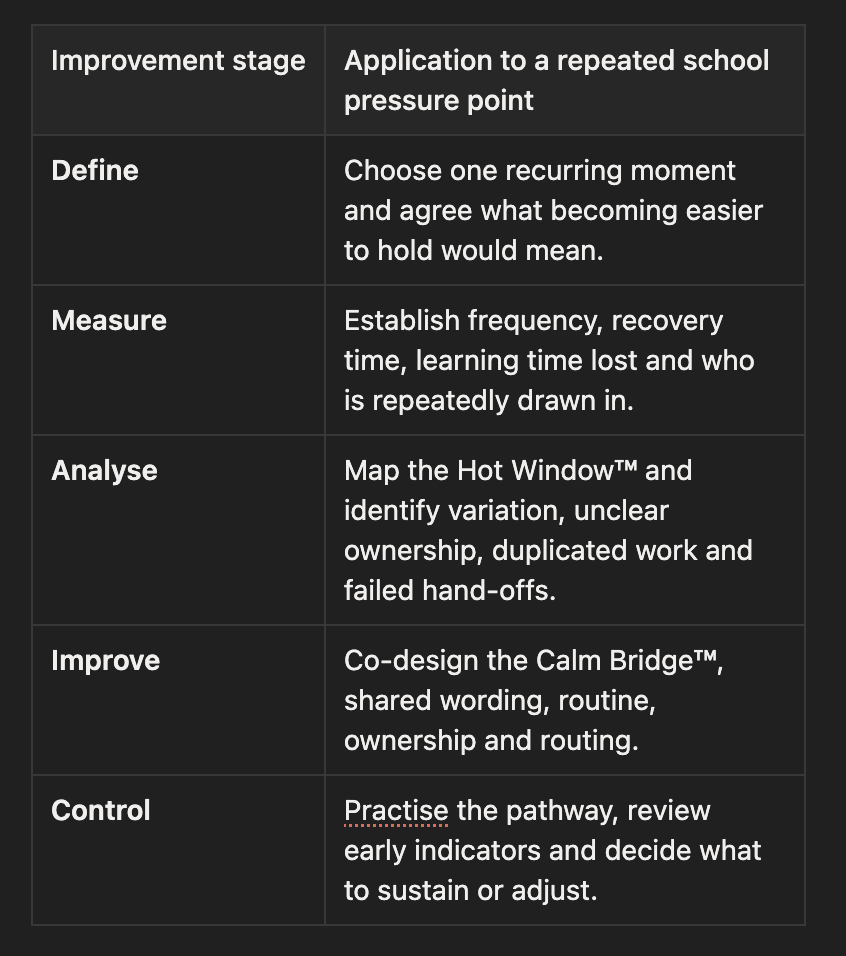
The combined AmbiSense® lens is straightforward:
Psychology helps explain what may be happening for the person under pressure.
Strategic HR makes the response workable for the adults responsible for delivering it.
Lean Six Sigma makes the pathway visible, testable and sustainable.
How does AmbiSense® help schools implement an inclusion strategy?
AmbiSense® helps schools and MATs turn a repeated pressure point into a practical pathway that staff can use, practise and review.
It does not replace an inclusion strategy, SEND duties, safeguarding decisions, clinical judgement or emergency action. It provides a focused implementation layer between what the strategy says and what people actually do when the pressure is on.
The 30-Day Calm Bridge™ Install starts with one recurring situation:
Notice: choose the repeated pressure point and agree what would make it easier to hold.
Map: trace the earlier "hot window", who is drawn in, and what the response and recovery consume.
Build: agree what adults will do and say, who owns each step, and where concerns are routed.
Practise and review: test the pathway, make adjustments and compare early indicators with the baseline.
The school receives a Hot Window Map™, shared first-response wording, clear ownership and routing, a practised Calm Bridge™, and a day-30 evidence summary. Pilot work starts at £3,000, subject to the setting, people involved and scope agreed during the initial conversation.
For a school preparing its inclusion strategy, this creates a concrete example of:
a barrier identified through school-level evidence;
an activity connected to relevant inclusion principles;
a visible change in adult practice;
staff and family participation;
implementation measures; and
an evidence trail for review.
For a MAT, the same method can identify a shared pattern while protecting the requirement for each academy's strategy to reflect its own cohort, barriers, spending and delivery.
AmbiSense® was created by Naomi Withers, founder of The HRologist Ltd. Naomi brings 25+ years of HR experience and a psychology-informed, practical approach to school systems, implementation and school-family pressure.
Where should a school start?
The deadline can make the task feel bigger than it needs to be. The strongest response is rarely a larger document.
Start with one moment that keeps costing pupils access, staff capacity or family trust. Name the barrier clearly. Decide what should change. Build a response people can actually use. Track whether it holds.
That gives your inclusion strategy something more valuable than polished wording: evidence that inclusion is becoming visible in practice.
Bring one repeated school pressure point.
In a confidential 20–30 minute scoping conversation, we will explore where the pathway first becomes difficult to use, what the repeated moment consumes, and whether a 30-Day Calm Bridge™ Install is a useful next step.
If there is a fit, the installation gives your school a defined baseline, a co-designed and practised response, clear ownership and routing, and a day-30 evidence summary. Pilot work starts at £3,000, with the exact scope agreed before commissioning.
Book a conversation with Naomi Withers or email hello@thehrologist.co.uk.
References
Department for Education and Ofsted
Inclusive mainstream fund for schools: conditions of grant 2026 to 2027, Department for Education, updated 1 July 2026.
Developing an inclusion strategy using the Inclusive Mainstream Fund, Department for Education, updated 7 August 2026.
Inclusive Mainstream Fund: best practice for schools, Department for Education, updated 7 August 2026.
Inclusive Mainstream Fund for schools: methodology 2026 to 2027, Department for Education.
Special educational needs in England: 2025 to 2026, Department for Education, published 11 June 2026.
State-funded school inspection toolkit, Ofsted, version 2.0, for inspections from 7 September 2026.
Inspection information for state-funded schools, Ofsted, updated 28 August 2026.
Psychological and implementation research
Štremfel, U., et al. Addressing the Sense of School Belonging Among All Students? A Systematic Literature Review, 2024.
Op den Kelder, R., et al. Executive functions in trauma-exposed youth: a meta-analysis, 2018.
Owens, J. S., et al. Implementation Science in School Mental Health: A 10-Year Progress Update and Development of a New Research Agenda, 2025.
AmbiSense® supports practical school pathways. It does not replace statutory safeguarding, SEND duties, clinical judgement, emergency procedures or legal advice. Responsible professionals retain those duties and decisions.
