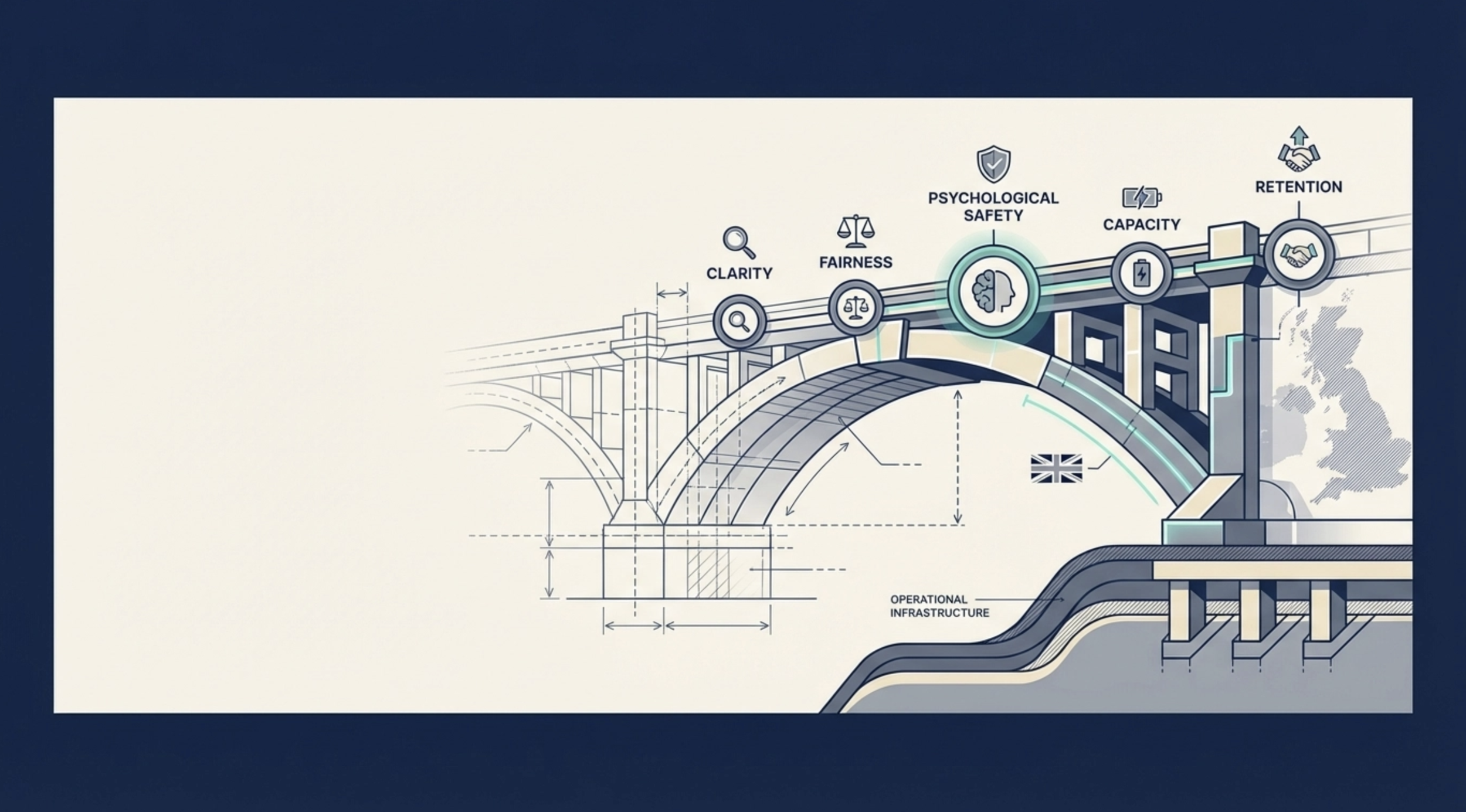
Emotional infrastructure for workplaces under strain
When people pressure rises, it does not stay neatly inside job descriptions.
It shows up as conflict, avoidance, absence, burnout, poor communication, low trust, reactive management, unresolved employee relations issues and leaders who are quietly carrying far too much.
AmbiSense® helps workplaces build the practical emotional infrastructure people need to think clearly, communicate safely, repair faster and keep working well under pressure.
This is not performative wellbeing.
This is people risk, leadership capacity and workforce stability - handled with clarity, humanity and structure.
HR-informed. Psychology-informed. Trauma-informed. Neurodivergence-aware. Built for real workplaces, not ideal ones.
Pressure → Pattern → Structure → Recovery → Performance
When emotional load has nowhere structured to go, it becomes business risk
Most workplace issues do not begin as formal problems.
They begin as missed signals.
A manager avoids a difficult conversation.
A team member stops speaking up.
A conflict is allowed to harden.
A high performer becomes overloaded.
A neurodivergent employee masks until they cannot.
A wellbeing issue becomes an absence issue.
A small misunderstanding becomes an employee relations case.
A leader spends more and more time absorbing emotional pressure that should have had a system around it.
By the time it reaches formal process, the organisation is often already paying for the lack of emotional infrastructure.
Not just in money.
In leadership bandwidth, retention, trust, pace of execution, reputation and culture.
The issue is not that people are too emotional
The issue is that many workplaces are not designed for how humans actually function under strain.
People do not become more rational simply because the stakes are high.
Under pressure, nervous systems protect.
That can look like:
defensiveness
withdrawal
over-explaining
silence
blame
avoidance
emotional escalation
perfectionism
people-pleasing
control
shutdown
presenteeism
burnout
Without structure, these responses become personal, messy and expensive.
With the right emotional infrastructure, people have clearer routes for communication, repair, decision-making and recovery.
What is workplace emotional infrastructure?
Workplace emotional infrastructure is the practical design that helps people stay safe enough to think, speak, lead and recover.
It is not a poster on psychological safety.
It is not a wellbeing webinar.
It is not telling managers to “have more empathy” without giving them the language, boundaries or routes to do it safely.
It is the working system around people pressure.
That includes:
clear communication routes
manager-ready scripts
emotionally intelligent leadership habits
psychologically safer meeting practices
conflict repair pathways
trauma-informed HR processes
neurodivergence-aware adjustments
reflective practice spaces
escalation and ownership routes
boundaries around emotional labour
light measures that show whether things are improving
In simple terms:
I help organisations stop relying on individual people to hold emotional pressure alone, and start building the structures that make steadiness possible.
❋
Not wellbeing. Infrastructure.
Wellbeing often asks people to cope better.
Emotional infrastructure asks:
What needs to change around people so they are not constantly forced into survival mode?
Because if your organisation only responds once people are already overwhelmed, absent, in conflict or formally complaining, the system is working too late.
Workplace emotional infrastructure creates earlier, safer and clearer routes.
So pressure can be noticed before it becomes crisis.
So managers know what to say before things escalate.
So teams can repair after difficult moments.
So HR is not left carrying every relational rupture.
So leaders protect continuity without becoming the emotional shock absorbers for the whole organisation.
This is for workplaces where people pressure is affecting performance
This work is for organisations, leaders, HR teams and managers who are noticing:
rising conflict or tension
managers avoiding difficult conversations
employee relations issues taking too much leadership time
burnout, absence or emotional exhaustion
poor communication under pressure
low psychological safety
staff feeling unsupported, unheard or unsafe
neurodivergent employees struggling without the right structure
teams relying on one or two “safe people” to hold everything together
values that sound good but do not yet hold under strain
wellbeing activity that is not changing the daily experience of work
You may not need another initiative.
You may need a clearer operating system for how people communicate, recover, repair and lead under pressure.
The AmbiSense® SENSE framework for workplaces
01
Intentional
Structure
02
Collaborative
Energy
03
Expert
Facilitation
03
Expert
Facilitation
03
Expert
Facilitation
Let’s Work TogetherIf you're interested in working with us, complete the form with a few details about your project. We'll review your message and get back to you within 48 hours.