

Compassionate Leadership and Employee Retention: Why Psychological Safety is Operational Infrastructure (UK)
How leaders in UK organisations and Multi‑Academy Trusts (MATs) reduce people risk, protect capacity, and keep good people, without “softening standards”.
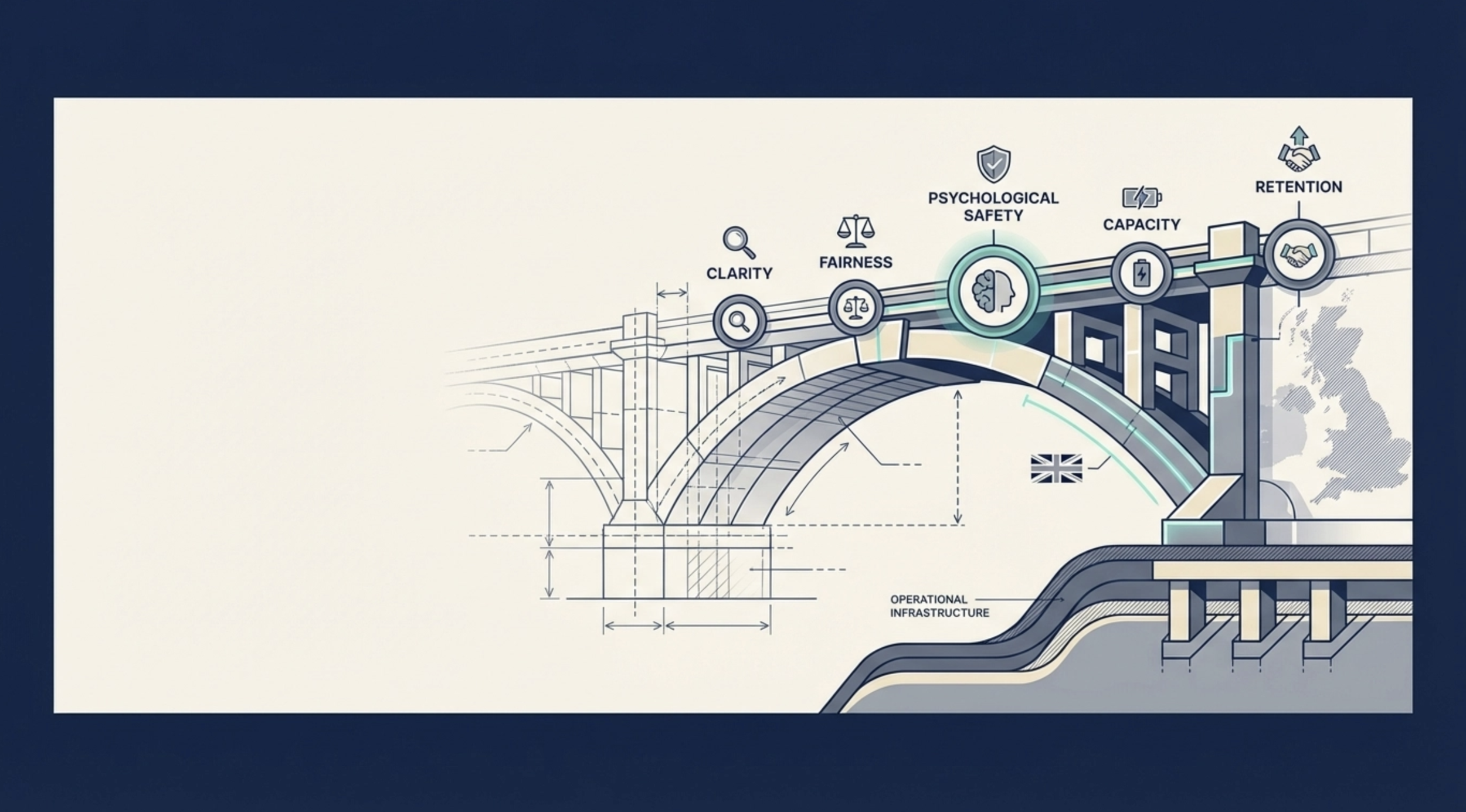
Alt text: Blueprint-style bridge illustration showing compassionate leadership and psychological safety as operational infrastructure supporting employee retention in the UK.
Most organisations don’t have an employee retention problem.
They have a capacity stability problem.
People rarely leave because they fancy a new job title. They leave after months (sometimes years) of operating under strain, when staying starts to cost more than leaving.
And one of the biggest “silent drivers” of that cost is this:
inconsistent leadership behaviour.
Not because leaders are bad people. Often, because leaders are overloaded, under-skilled in the human side of work, or operating inside systems that make good leadership hard to sustain.
That’s why compassionate leadership matters, but not in the fluffy, values-poster way.
Compassionate leadership is emotional infrastructure: the invisible conditions that shape whether humans can think clearly, speak up early, recover, and perform consistently.
What compassionate leadership actually is (and what it isn’t)
Compassionate leadership isn’t “being nice”.
A useful evidence-based definition is a three-part process:
noticing suffering → feeling empathic concern → responding with action (Dutton et al., 2006).
In practice, that action looks like:
checking in and listening properly (not performative “you ok?”)
adjusting workload when capacity drops (not waiting for collapse)
giving clarity when uncertainty is spiking (not leaving people guessing)
having tough conversations with dignity (not shame)
making fairness visible, not assumed
So no this isn’t permission to drop standards.
If anything, the best compassionate leaders are often the clearest: they set predictable expectations, make transparent decisions, and repair quickly when something goes wrong.
Compassionate leadership and employee retention: what’s really going on
When compassionate leadership is present, it protects employee retention through well-established mechanisms:
1) Psychological safety at work (your early-warning system)
When people feel psychologically safe, they speak up earlier:
earlier about strain
earlier about mistakes
earlier about risks
earlier about conflict
That matters because most people issues become expensive when they go underground.
Recent research links compassionate leadership to psychological safety and lower emotional exhaustion (Kim, Lee & Park, 2023).
2) Perceived organisational support (what people infer your culture really is)
Employees interpret “the organisation” through their manager’s behaviour.
If leaders are attentive, fair, and humane under pressure, employees infer:
“I matter here.”
That perception is strongly linked to commitment and retention dynamics (Eisenberger et al., 1986).
3) The Job Demands–Resources (JD‑R) model (why some teams cope and others collapse)
The JD‑R model explains burnout and engagement through the balance of demands and resources (Bakker & Demerouti, 2007).
Compassionate leadership functions like a resource multiplier. It doesn’t remove all demands, but it increases access to resources like:
role clarity
autonomy
feedback
prioritisation
social support
That’s what protects capacity.
And capacity - more than motivation - is what determines whether people stay.
The “same problem, different uniform”: CEOs and MATs are dealing with the same infrastructure issue
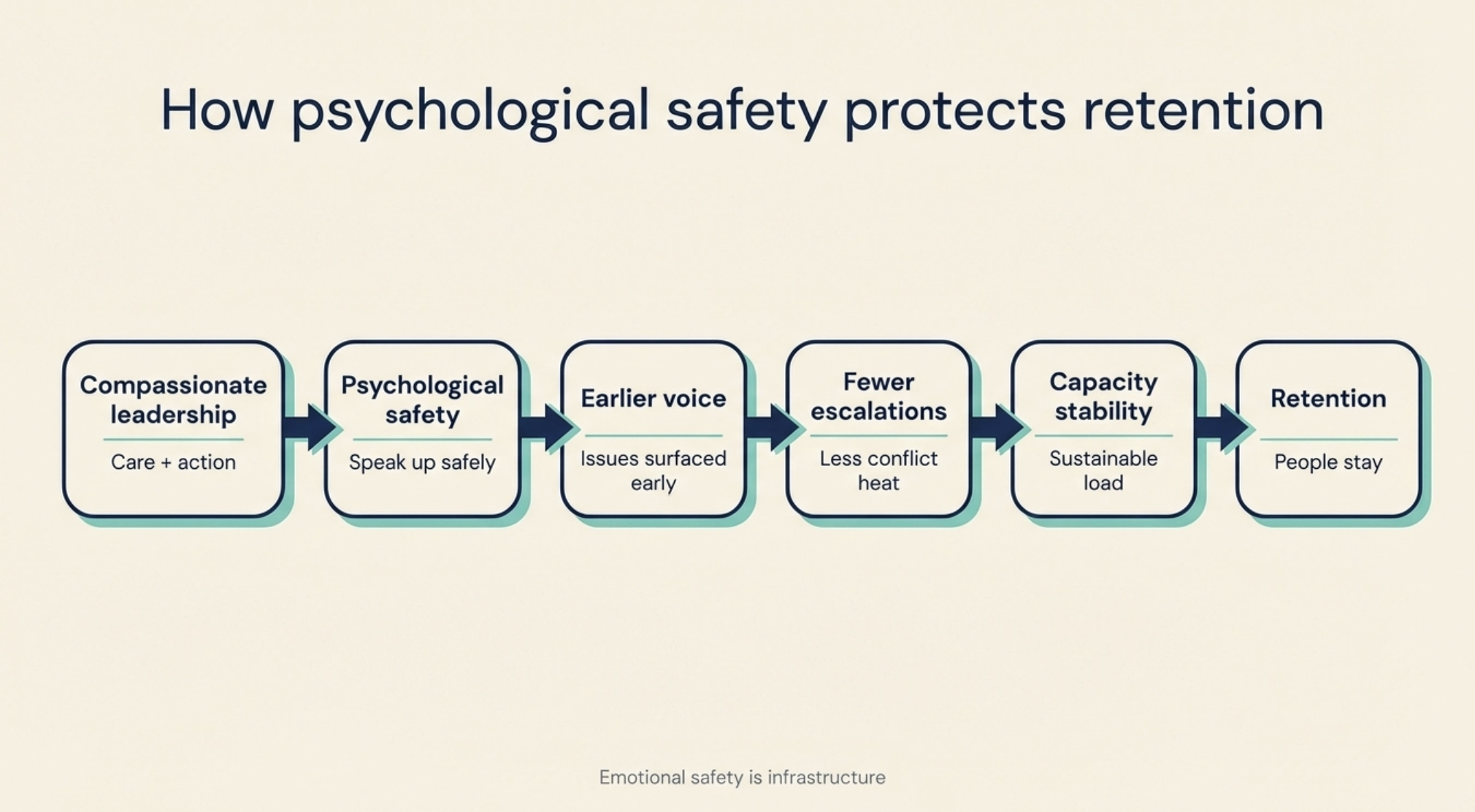
Alt text: How psychological safety at work improves employee retention in UK organisations.
In corporate organisations, this tends to surface as quiet withdrawal of effort, rising absence, manager inconsistency, and avoidable attrition in key roles.
In UK schools and Multi‑Academy Trusts (MATs), the same mechanism shows up through cover pressure, safeguarding volume, SEND escalation load, attendance drift, exclusions, and leaders carrying emotional load manually.
Different settings—same infrastructure problem: when psychological safety is weak, systems run hotter, recovery takes longer, and people leave.
Alt text: How psychological safety at work improves employee retention in UK organisations.
What my HR practitioner's data found (and the warning label)
I gathered primary data via a short questionnaire with HR practitioners across multiple sectors and organisation sizes. This is not statistically generalisable, but it is a useful practice insight.
Compassion was consistently perceived as retention‑protective
Respondents repeatedly linked compassionate leadership to:
Employees feeling valued
belonging and loyalty
leaders “having your back” during life events (bereavement, illness, family pressure)
In plain terms: people stay where they feel safe when life gets hard.
The barriers were structural, not motivational
Barriers were consistent:
time scarcity and overloaded leaders
policy rigidity and limited discretion
fairness tensions (“if we do this for one person, what about everyone else?”)
commercial constraints where delivery always wins
CEO translation:
Compassion doesn’t fail because leaders don’t care. It fails because organisations don’t build the conditions for it to be repeatable.
The warning label: compassion without clarity can backfire
If compassion becomes:
avoiding hard conversations
retaining poor performance indefinitely
applying flexibility inconsistently
letting workload silently transfer to colleagues
…then compassion is experienced by the wider team as unfairness.
And unfairness is a fast track to disengagement and attrition.
Compassion + clarity = retention protection
Compassionate leadership is most retention‑protective when it is predictable.
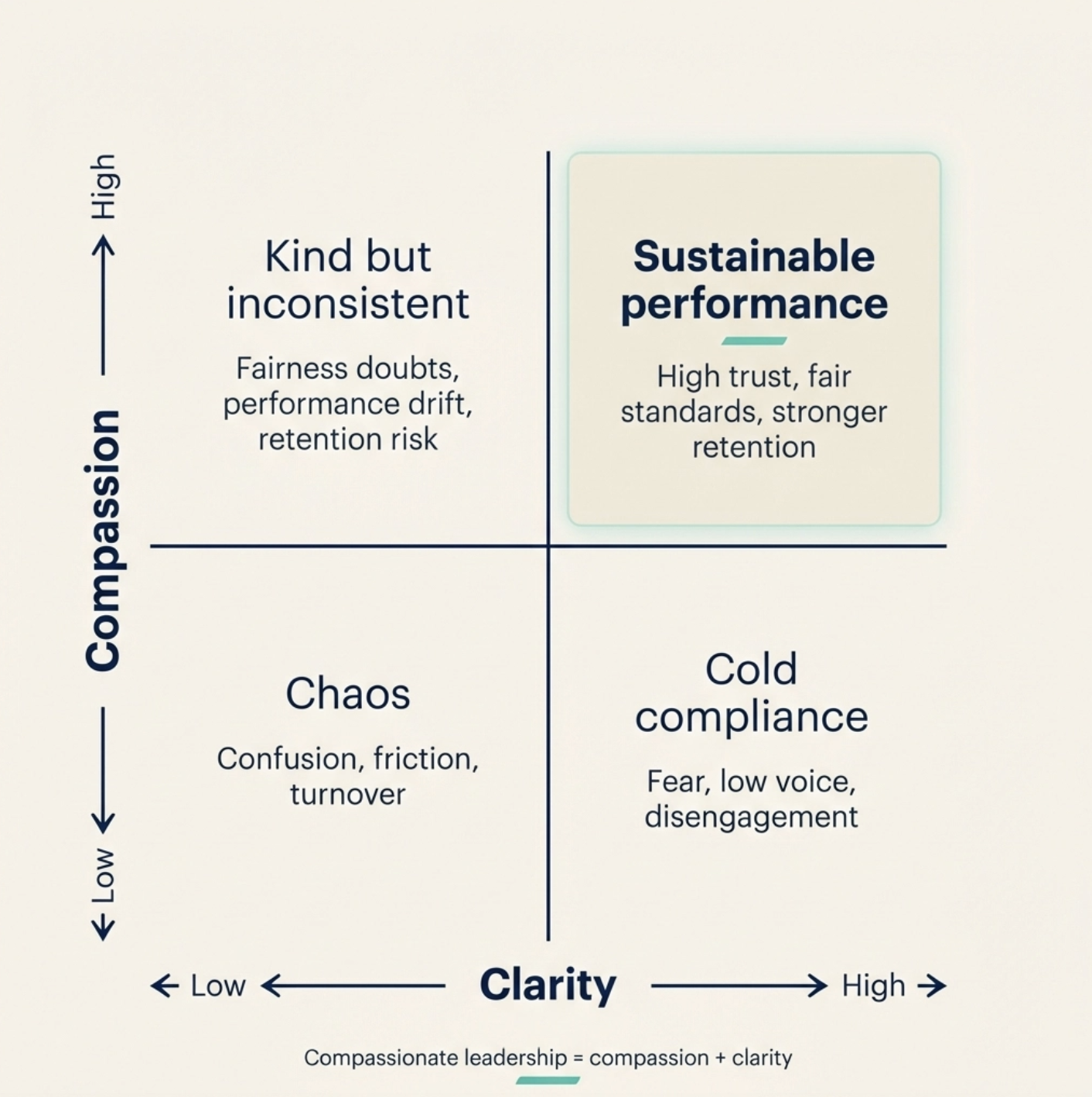
Alt text: Compassionate leadership matrix showing clarity, fairness and employee retention outcomes.
Alt text: Compassionate leadership matrix showing clarity, fairness and employee retention outcomes.
That means:
standards stay clear
performance is addressed early (with dignity)
discretion has guardrails
workload is actively managed
fairness is made visible
This is how you turn “nice intention” into operational stability.
The 3 takeaways (save this)
Retention is reputation - people leave cultures, not contracts.
Cost isn’t recruitment, it’s leadership bandwidth - turnover drains the system.
Emotional safety is infrastructure - when it’s missing, everything costs more.
How to build compassionate leadership (without turning it into “softness”)
If compassionate leadership is emotional infrastructure, HR’s job is to build it like infrastructure:
Define the standard: “Compassion + accountability”
Don’t assume shared definitions. Write it down. Model it. Train it. Measure it.
Build micro‑skills (not values posters)
Managers need capability uplift in:
active listening
emotion‑labelling (without “therapy‑ing” staff)
prioritisation and workload calibration
boundary‑setting
performance conversations without shame
Fix the blockers (time, decision rights, workload realism)
If leaders have no time, no discretion, and no authority to adjust workload, compassion becomes performative.
Create fairness guardrails
Equity isn’t sameness—but the decision logic must be visible.
Measure it like a strategic capability
Use leading indicators:
psychological safety items
fairness signals
workload sustainability/capacity measures
retention risk hotspots
If you can’t evidence it, you can’t defend it when pressure hits.
FAQ: compassionate leadership, psychological safety and retention (UK)
What is compassionate leadership in the workplace?
Compassionate leadership is the practical ability to notice strain, respond with dignity, and take action that restores clarity, fairness, and capacity—without dropping standards.
Does compassionate leadership improve employee retention?
Evidence suggests it supports retention through psychological safety, perceived organisational support, and reduced emotional exhaustion—especially in high-demand UK workplaces.
What is psychological safety at work?
Psychological safety is when people can speak up, ask for help, admit mistakes, and raise concerns without fear of humiliation or punishment.
Why does this matter for Multi‑Academy Trusts (MATs)?
In MATs and UK schools, psychological safety affects staff stability under safeguarding and SEND pressure, behaviour escalation cycles, and time‑to‑recovery after incidents—directly impacting retention and leadership bandwidth.
If you want the implementation layer (AmbiSense®️)
If you want compassionate leadership to hold under pressure (not just in calm weeks), you need emotional infrastructure - clear standards, practical scripts, and fairness guardrails that protect capacity.
AmbiSense is the implementation layer I use to turn psychological safety into repeatable day‑to‑day practice across organisations and UK schools/MATs:
Book a consultation: https://calendly.com/thehrologist/workwithme
References
Bakker, A.B. & Demerouti, E. (2007). Job Demands–Resources theory. Journal of Occupational Health Psychology, 12(3), 309–328.
Dutton, J.E., Worline, M.C., Frost, P.J. & Lilius, J.M. (2006). Explaining compassion organizing. Administrative Science Quarterly, 51(1), 59–96.
Eisenberger, R., Huntington, R., Hutchison, S. & Sowa, D. (1986). Perceived organisational support. Journal of Applied Psychology, 71(3), 500–507.
Kim, S., Lee, J.Y. & Park, S. (2023). Compassionate leadership, psychological safety and emotional exhaustion. Journal of Occupational Health Psychology, 28(1), 104–118.
