

Nervous system regulation: what it means and how to reset
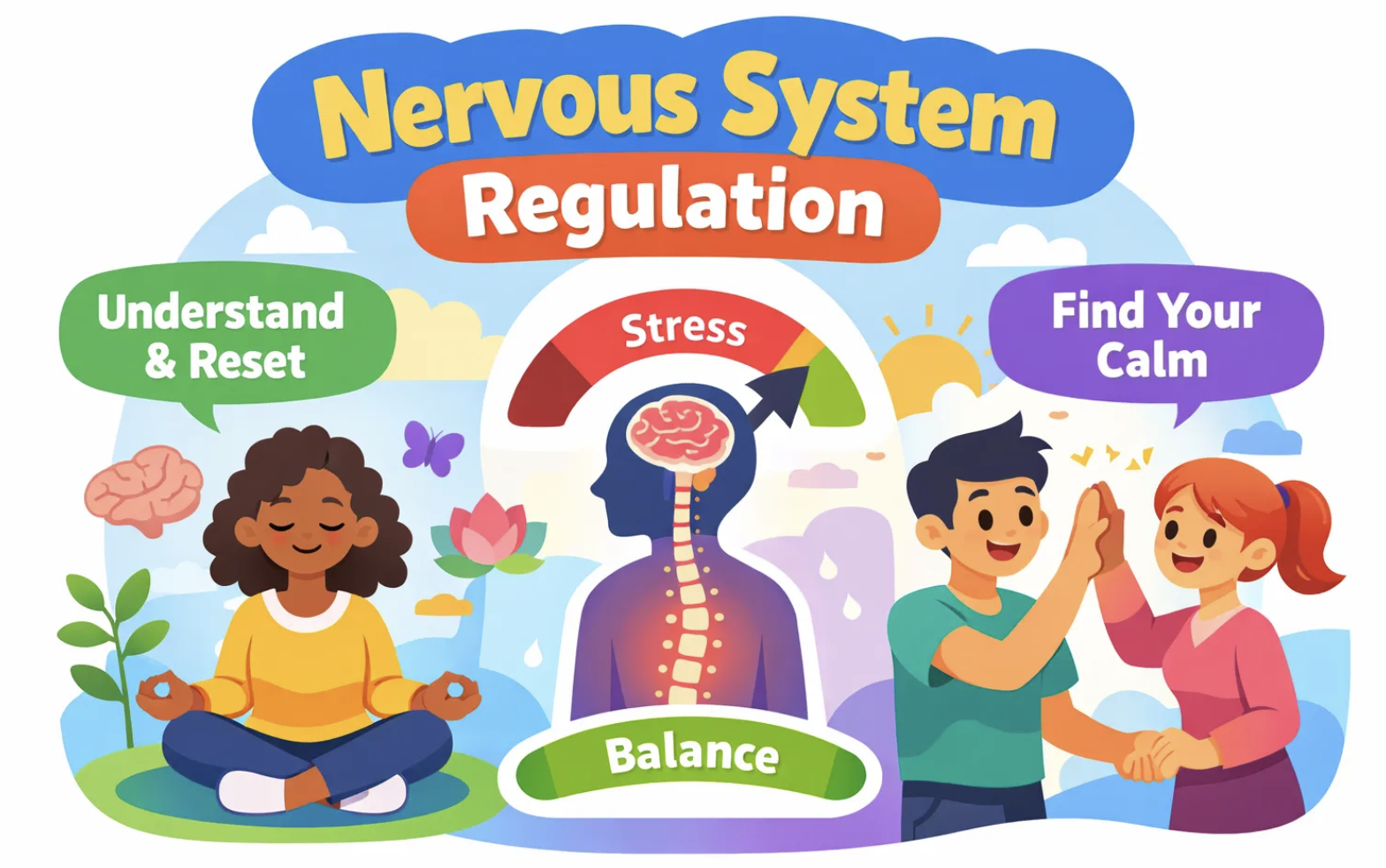
You snap at someone you love over something small.
You go completely blank in an important meeting.
You lie awake at 2am, replaying a conversation from six days ago.
That's not a character flaw, and it's not a reflection of how much you care or how capable you are. Nervous system regulation explains what's actually happening: your autonomic nervous system (ANS) is doing precisely what it was designed to do, and it needs a reset.
Nervous system regulation is the ANS's capacity to shift between arousal and calm and return to a functional baseline. That definition sounds simple, but the mechanics behind it explain more about human behavior, learning, and leadership than most people realize.
At The HRologist, every engagement starts here, because you can't engineer emotional infrastructure for a family, school, or workplace without first understanding the system you're designing for.
This article breaks down what regulation actually means biologically, what dysregulation looks like across different environments, and gives you a practical three-tier toolkit grounded in evidence so you can reset when you need to.
What nervous system regulation actually means
The autonomic nervous system's two operating modes
Your autonomic nervous system runs continuously in the background, managing heart rate, breathing, digestion, and your response to anything it reads as a threat. It operates through two primary branches: the sympathetic system, which mobilizes you for action, and the parasympathetic system, which returns you to rest and recovery.
Think of them as an accelerator and a brake.
Both are essential.
The problem isn't having them; it's getting stuck in one.
Nervous system regulation is not the absence of a stress response. It's the ability to move between activation states and return to baseline efficiently.
When the accelerator fires to get you through a crisis and the brake engages afterward so you can recover, that's a regulated nervous system working exactly as intended. Dysregulation is what happens when the brake stops working reliably.
Polyvagal theory in plain language
Neuroscientist Stephen Porges expanded this picture with polyvagal theory, which maps three distinct autonomic states rather than two. The ventral vagal state is the calm, socially engaged baseline: you feel safe, you can think clearly, and you can connect with others. The sympathetic state is fight-or-flight, mobilised and alert. The dorsal vagal state is the most primitive: freeze and shutdown, a collapse response when threat overwhelms the system completely.
What drives these shifts is something Porges called neuroception, a subconscious threat-scanning process operating below conscious thought. Your body is constantly reading the room: tone of voice, facial expressions, noise levels, predictability of the environment. It processes this information and selects a state before your thinking mind has a chance to weigh in. This is why you can walk into a room and immediately feel unsafe without knowing why.
The window of tolerance and what it tells you
The window of tolerance describes the arousal zone where you can function effectively: your thinking stays clear, your emotions are manageable, and you can respond rather than react. Inside that window, the accelerator and brake balance each other. Outside it, above or below, cognitive function degrades and behavior becomes harder to control.
This window is not fixed. Chronic stress narrows it, making it easier to get pushed out by smaller and smaller triggers.
Consistent sleep,
Safe relationships,
Predictable routines,
and practiced regulation techniques widen it over time. Vagal tone, a measurable index of how well the parasympathetic system responds, improves with targeted practices and reflects your overall regulatory capacity.
The stress response decoded: why nervous system dysregulation happens
How the brain and body respond to perceived threat
The sequence begins with neuroception. The body detects a signal, the amygdala fires a threat response, and the HPA axis releases cortisol and adrenaline to prepare you for action. Here's the critical detail: the threat does not have to be physical or even real. An unanswered email, a tense silence in a meeting, or a child's meltdown triggers the same biological cascade as an actual physical danger.
Up-regulation looks like hyperarousal:
anxiety,
irritability,
racing thoughts,
and physical restlessness. Down-regulation looks like the opposite:
shutdown,
numbness,
flat affect, and exhaustion.
Both are forms of dysregulation. They just sit at opposite ends of the same spectrum, above and below the window of tolerance respectively. For a clear consumer-friendly overview of what nervous system dysregulation looks like and how it's discussed clinically, see this summary on what nervous system dysregulation is.
Why modern life keeps people stuck outside their window
The nervous system evolved to handle short, acute threats followed by recovery. A predator appears, the body mobilizes, the threat resolves, and the system resets. Contemporary stressors don't work that way. Work deadlines, sensory overload, relational conflict, financial pressure, and disrupted sleep don't have a clear resolution point.
They stack on each other, and the ANS stays activated with no reliable "all clear" signal.
The result is the exhausted-but-wired experience that many people normalise: too tired to function but too activated to rest. This is a hallmark of chronic dysregulation, and it rarely resolves on its own. Without deliberate intervention, the pattern compounds.
How nervous system dysregulation shows up in real life
Physical and behavioral signs to recognise
Physiological signs include muscle tension, jaw clenching, racing heart, disrupted sleep, persistent fatigue, digestive issues, and heightened sensitivity to noise or light. Behavioral signs include emotional overreactions, brain fog, difficulty concentrating, startling easily, withdrawal, mood swings, and an inability to sit still. These are not personality traits. They are signals.
The two clusters, hyperarousal and hypoarousal, look opposite but share the same root cause.
Hyperarousal presents as reactivity, restlessness, and anxiety.
Hypoarousal presents as flatness, disconnection, and low motivation.
Recognising which state you're in matters because the tools that help are different for each.
What dysregulation looks like at home, in school, and at work
At home, it looks like a parent who snaps over spilled milk, a child who dissolves during a simple transition, a household where conflict escalates faster than anyone can explain.
At school, it's a student who genuinely cannot focus, not because they're defiant but because their nervous system is in fight-or-flight. It's a classroom where three difficult moments derail the entire afternoon, or a teacher running on empty by October with no clear reason why.
At work, it's a team that avoids the hard conversations, a manager whose communication style shifts noticeably under pressure, and an organization that frames burnout as a workload problem when the actual driver is regulation capacity.
The pattern is consistent across every context: when the nervous system is dysregulated, behavior, learning, and relationships all deteriorate, and the environment usually gets the blame.
A tiered toolkit for resetting your nervous system
30-second resets: fast-acting techniques
The physiological sigh is a rapid pattern interrupt: take a double inhale through the nose, then a long, slow exhale through the mouth. This deflates overinflated air sacs in the lungs and is thought to activate the parasympathetic brake within seconds, though the mechanism is plausible rather than RCT-confirmed.
Splashing cold water on your wrists or face may trigger a drop in heart rate via the dive reflex, a physiological response to cold facial exposure that has a well-established basis in mammalian biology.
The five-four-three-two-one grounding technique redirects attention to sensory input and is widely used clinically to interrupt a threat narrative. It works by noticing five things you see, four you can touch, three you hear, two you smell, and one you taste.
These are pattern interrupts, not cures. Their purpose is to create a brief opening for the prefrontal cortex to re-engage, giving you enough space to choose what comes next rather than simply reacting. They work best when practiced before you need them, so the nervous system already recognizes the signal.
3-minute practices for moderate activation
Slow breathing protocols, including box breathing and extended exhale breathing, are among the better-studied short-duration techniques. Box breathing uses four counts in, four counts hold, four counts out, and four counts hold.
Extended exhale breathing uses an inhale of four counts and an exhale of six to eight. Some controlled studies show reductions in anxiety scores with slow-breathing practices, though effect sizes vary and evidence for these specific named protocols is still developing.
The extended exhale pattern is worth prioritizing: lengthening the exhale directly stimulates the vagus nerve, and even a few minutes of this rhythm may be enough to shift state perceptibly.
Orienting practice is another option: slowly scan the room and let your eyes rest on something neutral and unthreatening. Clinically, this is understood to communicate a safety signal through the visual system, though direct measurement of its effect on vagal tone in controlled settings is limited. Light bilateral movement, a short walk or gentle tapping that alternates sides, is similarly used in trauma-informed practice to support a return toward calmer baseline states.
10-minute routines for deeper regulation
Sustained diaphragmatic breathing for ten or more minutes supports measurable improvements in heart rate variability and longer-lasting parasympathetic tone. Combining this with grounding, direct skin contact with a natural surface, may amplify the effect.
A 2017 prospective study in preterm infants found a 67% increase in vagal tone during earthing conditions; adult evidence points in a similar direction, though it is more preliminary and less consistently characterized than the NICU findings. (See the report on the NICU grounding technique here.)
A regulation check-in journal entry completes the tier: identify which state you're in, name what triggered the shift, and choose a corresponding tool. The act of naming a feeling reduces limbic reactivity.
Research suggests that labeling an emotional state partially transfers processing from the amygdala to the prefrontal cortex, restoring cognitive access. This isn't abstract journaling advice; it's a documented neurological mechanism with roots in affect-labeling research.
When the environment is the problem, not you
Why putting regulation entirely on the individual fails
Giving someone a breathing technique while leaving the dysregulating environment unchanged is like handing them an umbrella and refusing to fix the leaking roof. The tool is real, and it helps. But it doesn't address what's generating the problem.
When dysregulation is chronic and widespread across a household, a classroom, or an organisation, that's a structural signal, not a collection of individual failures.
Sensory overload, unpredictable transitions, fractured routines, and absent psychological safety are environmental conditions that make nervous system regulation consistently harder regardless of personal effort. No amount of individual practice fully compensates for an environment that relentlessly demands regulation without ever supporting it.
What systems-level regulation looks like in practice
The AmbiSense® framework at The HRologist approaches this differently. Rather than layering coping strategies onto dysregulating conditions, the work focuses on redesigning the environment itself: predictable rhythms, shared emotional language, sensory-informed spaces, and routines that signal safety before a threat is even perceived. The goal is to engineer the conditions so stability becomes structural, not personality-dependent.
This systems-level approach applies across home, school, and workplace settings using the same underlying framework, because the nervous system doesn't compartmentalize by context. The same person who shuts down in a dysregulating classroom carries that pattern home, and brings the same biology into the Monday morning meeting. Organisational research on psychological safety and environment design suggests that structural conditions, not just individual coping, predict outcomes like staff retention, conflict frequency, and team performance, and that's the level The HRologist works at.
When to seek professional support
Self-regulation tools are powerful starting points, but they have limits. If you're experiencing persistent sleep disruption, dissociation, emotional numbness, or chronic physical symptoms that don't shift with consistent practice, a toolkit isn't the right primary intervention.
When dysregulation is rooted in unprocessed trauma, developmental history, or clinical conditions like PTSD, the window of tolerance is often too narrow for self-directed tools to widen safely without therapeutic support alongside them.
Clinicians, therapists, and practitioners working within a neuro-affirmed, trauma-informed frame can provide the co-regulation that self-directed tools can't replicate. This matters most for children, adults recovering from chronic stress exposure, and teams operating in high-stakes environments. Seeking that support is not evidence that the tools failed. It means the load is larger than any individual should carry alone, and that's not a personal limitation; it's a recognition that humans are fundamentally relational beings who regulate best in connection.
Regulation is a system, not a habit
Nervous system regulation is the ANS's ability to shift between arousal and calm, and return to baseline. Dysregulation isn't weakness. It's a system responding honestly to genuine signals, doing exactly what it was built to do, often in conditions it was never designed for.
The three-tier toolkit gives you real points of entry: a 30-second interrupt when you're about to react, a 3-minute reset when you're moderately activated, and a 10-minute practice when you need to rebuild baseline. These techniques have real clinical and research grounding, particularly slow-breathing protocols and affect labeling, though effects vary by individual and context. They work best when the environment you're returning to isn't actively working against you.
Lasting regulation is not just a personal practice. It's a design problem.
If your home, school, or organisation needs more than a breathing technique, The HRologist works with families, school districts, and people teams to build the kind of emotional infrastructure where regulation doesn't depend on any one person holding everything together. That's where the real shift happens. We also provide practical resources you can use immediately, such as CalmCards ™️ and the Family Calm Kit (Digital Download), to help embed these practices into daily routines.
