

Why behaviour charts backfire (and what to use instead)
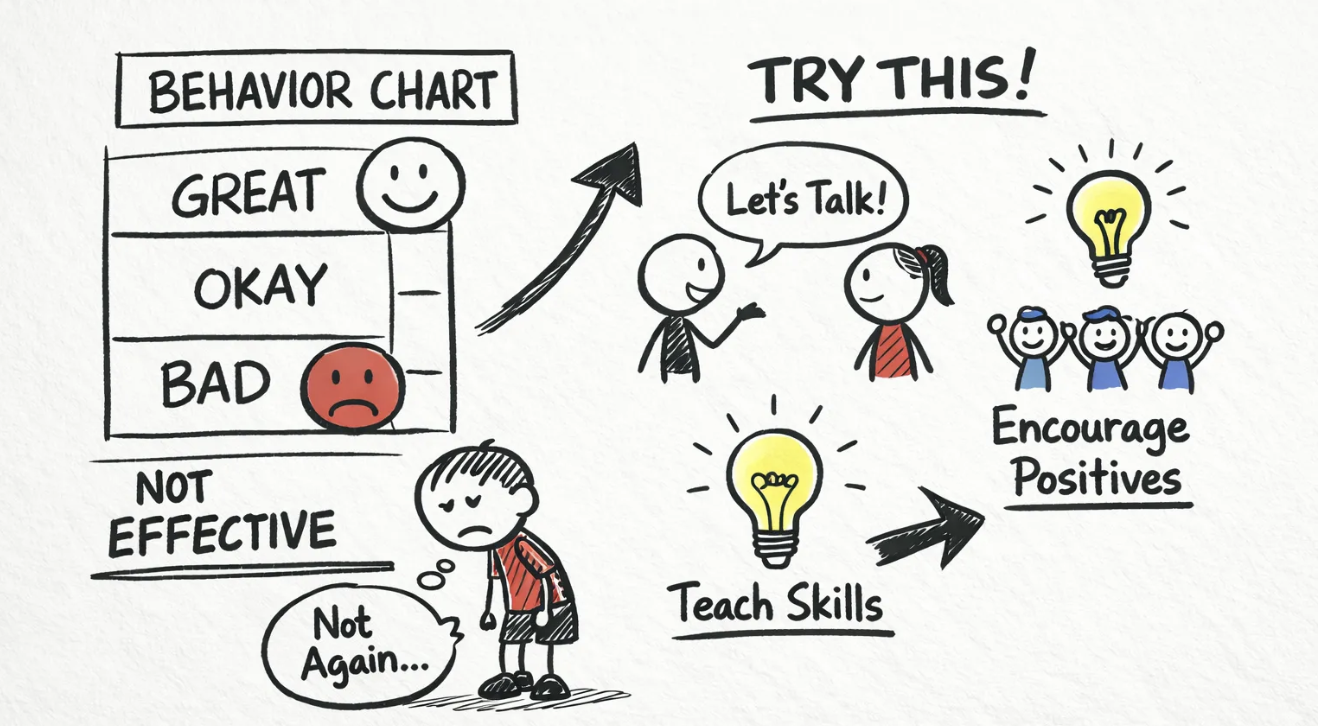
Picture Monday morning as a classroom teacher: you've set up the behaviour chart on the wall with fresh colours and clear expectations. By Thursday, the same two or three pupils have a column of red marks. The rest of the class barely glances at it. By Friday, nothing has changed except the tension in the room, and those pupils now carry a visible record of failure in front of their peers.
If you’ve used a clip chart, a traffic light behaviour chart, or any kind of public “move up / move down” system, this will feel familiar.
The chart isn't failing because you're applying it wrong. It's failing because it's a compliance tool deployed in the middle of a regulation problem. That mismatch is the whole issue. Behaviour charts assume pupils are choosing to disrupt and need a visual reminder to do better. Neuroscience tells a different story entirely.
Key takeaways (for busy teachers)
Behaviour charts measure compliance, not regulation capacity.
Public tracking can add shame/social threat, which predicts escalation or shutdown.
Under stress, executive function reduces—so consequences often don’t “land” mid‑dysregulation.
Small swaps (privacy, predictability, co‑regulation, repair) restore learning faster.
What behaviour charts measure (and what they miss)
Tracking compliance vs. reading the signal underneath
Behaviour charts are designed to modify pupil conduct through visual accountability and reward–punishment cycles. In practice, they track the output of a dysregulated nervous system while doing little to address the input. A pupil who repeatedly earns red marks isn't making a deliberate choice to disrupt the lesson. They’re cycling through a stress response they don't yet have the capacity to self-manage, and they need a different kind of response than a clip moved down a chart.
What the chart measures is surface behaviour. What it misses is the underlying state producing that behaviour. Teachers who understand this distinction stop asking “How do I get this pupil to comply?” and start asking “What is this pupil’s nervous system communicating right now?” That shift in question changes every response that follows.
When the chart becomes the problem
Public tracking adds a layer of shame that raises a pupil’s threat response rather than lowering it. When a child sees their name at the bottom of a visible chart in front of their peers, the brain is less likely to register it as motivation. For many children, particularly those with trauma histories, it registers as danger. The behaviour that follows isn't defiance as a character trait; it's a predictable physiological response to feeling unsafe in the learning environment.
Shame research (including Tangney and colleagues) shows that when shame is activated, cognitive function contracts sharply; attention redirects away from the task and toward perceived threat, with increased withdrawal and anger responses (Tangney and Dearing, 2002; Stuewig et al., 2010).
The neuroscience: why punishments escalate dysregulation
What happens in the brain when a child is dysregulated
Under stress, cognition narrows and the brain prioritises survival and threat detection over reflection and flexible problem-solving (Sapolsky, 2004). A lot of classroom behaviour relies on executive functions such as inhibition, working memory, and cognitive flexibility (Diamond, 2013). When stress rises, those capacities dip, making it harder to pause, switch tasks, or use language to negotiate.
That means a pupil operating from a threat state often cannot process consequences, respond to reminders, or follow complex instructions in the same way a regulated brain can. Punishment applied in that moment doesn't teach; it amplifies the stress response and makes re‑regulation harder (Sapolsky, 2004; Diamond, 2013).
In children, this effect is especially significant because the prefrontal cortex continues developing into early adulthood. The reactive systems of the brain are dominant by default under pressure. When a teacher escalates a consequence during a dysregulated moment, they're adding fuel to a fire that's already burning on a limited supply of regulatory capacity.
How the shame cycle keeps pupils stuck
Traditional behaviour management often increases pressure when a strategy stops working: more restrictions, greater visibility, harsher consequences. Neuroscience points directly in the opposite direction. Repeated activation of the stress response in a school environment can create a chronic dysregulation pattern that makes learning structurally harder over time, not just in that moment (Sapolsky, 2004).
The goal isn't to manage the behaviour; it's to interrupt the pattern that produces it. That distinction is the foundation of nervous system‑informed teaching. The pupil isn't the problem. The unmet regulatory need is the problem.
What dysregulation really looks like in the classroom
Dysregulation doesn't always look like a full meltdown. In real classrooms it often looks like:
blank staring/“stuck” on work they could do last week
defiant eye‑rolling or “attitude”
excessive fidgeting/restlessness
sudden escalation over something that seems trivial
flat refusal to engage
shutdown (hood up, hiding, going quiet)
disproportionate reactions to correction, transitions, or perceived unfairness
The pupils who frustrate classroom teachers most are often the ones whose dysregulation reads as laziness or deliberate defiance rather than distress. Recognising these presentations as signals rather than choices is the first step toward a response that actually moves things forward.
The connection between stress, survival mode, and learning
Pupils who arrive at school carrying stress from home, environmental instability, or unprocessed sensory overload are operating with limited regulatory capacity. They’re using most of their cognitive and physiological resources just to stay present in the room. There's very little bandwidth left for learning, collaboration, or behavioural compliance.
When a teacher responds to survival behaviours with punishment, the classroom becomes another source of threat. At that point, the pupil’s nervous system has nowhere safe to land in the school day. Shifting this dynamic starts with recognising that what looks like noncompliance is often the most regulated behaviour that pupil can manage in that moment.
What to use instead (ordinary‑day swaps)
Regulation before redirection: the practical pivot
A powerful immediate alternative to a behaviour chart is co‑regulation. Before redirecting a dysregulated pupil, the adult regulates first: slower speech, lower volume, a calm and steady physical presence. The pupil’s nervous system begins to mirror that state.
Co‑regulation is not permissive. It is neurologically grounded: regulation supports access to executive functions, which support behaviour and learning (Diamond, 2013; Perry, 2006).
Build predictability and sensory anchors into routine
Predictable transitions, consistent sensory cues, and structured arrival routines reduce the number of daily stress spikes pupils experience. Specific practices that cost nothing include:
a visual schedule posted consistently in the same location
a brief grounding moment before transitions (pressing feet to the floor, a few slow exhales, a two‑word emotion check‑in)
a calming corner pupils choose to use (not a place they are sent to as a consequence)
Micro‑practices that help:
visual timers and transition warnings (reduce anticipatory anxiety)
call‑and‑response signals (condition smooth transitions without raising threat)
brief breathing cues before lessons (support settling and focus)
These aren't additions to the school day. They're redesigns of moments that already exist. The goal is to make regulation a structural feature of the classroom environment rather than a reactive measure deployed after things have already gone wrong. (At whole‑school level, sustainable implementation does usually require dedicated planning time and staff support.)
Remove shame; keep accountability: repair after the moment
Accountability works best after regulation, not during escalation. Aim for brief, private repair:
“What happened?”
“What was hard / what was the need?”
“What do we need to put right?”
“What’s the plan for next time?”
Why individual teacher effort isn't the whole answer
The limits of classroom‑level fixes in a system‑level problem
When a teacher implements everything in this article and still hits walls, it's often because the wider school environment isn't built to support regulation. Hallways, lunch transitions, inconsistent adult responses across staff, and unstructured periods all affect how a pupil’s nervous system moves through the school day. One regulated classroom inside a dysregulating school is a meaningful contribution, but it's a partial solution to a whole‑environment problem.
Teachers absorb enormous regulatory load when they're the only consistent source of calm in a pupil’s day. Over time, that load contributes directly to educator burnout. The system, not just the classroom, needs to change.
Definitions (so we’re using the same language)
Dysregulation: a stress/threat state where thinking, language and self‑control are reduced; behaviour becomes a signal of overload.
Co‑regulation: an adult lending calm nervous‑system “stability” (tone, pace, presence) so a pupil can return to regulation.
Executive functions: brain‑based skills that support self‑control, working memory, flexible thinking and learning (Diamond, 2013).
Shame vs guilt: shame is self‑focused (“I am bad”) and predicts withdrawal/anger; guilt is behaviour‑focused (“I did something wrong”) and is more linked to repair (Tangney and Dearing, 2002).
References
Deci, E.L. and Ryan, R.M. (2000) ‘The “what” and “why” of goal pursuits: Human needs and the self-determination of behavior’, Psychological Inquiry, 11(4), pp. 227–268.
Diamond, A. (2013) ‘Executive functions’, Annual Review of Psychology, 64, pp. 135–168.
Perry, B.D. (2006) ‘Applying principles of neurodevelopment to clinical work with maltreated and traumatized children’, in Boyd Webb, N. (ed.) Working with Traumatized Youth in Child Welfare. New York: Guilford Press, pp. 27–52.
Sapolsky, R.M. (2004) Why Zebras Don’t Get Ulcers. 3rd edn. New York: Henry Holt.
Stuewig, J., Tangney, J.P., Heigel, C., Harty, L. and McCloskey, L. (2010) ‘Children’s proneness to shame and guilt predict risky and illegal behaviors in young adulthood’, Child Psychiatry & Human Development, 41(1), pp. 1–19.
Tangney, J.P. and Dearing, R.L. (2002) Shame and Guilt. New York: Guilford Press.
