

Rising Needs Need More Than a Quick Fix (2026/27): The AmbiSense Infrastructure Approach

Audience: MAT exec teams, headteachers, SENCOs and inclusion leaders planning for 2026/27.
Purpose: turn “rising need” into a September ready, inspection aware plan that builds capacity and consistency under strain (not another bolt-on).
Beyond “quick fixes”: the problem is consistency under strain
Rising need in schools isn’t a problem we solve with “more support”. It’s a problem of maintaining consistency under strain — especially in the predictable parts of the day where systems run hot.
Across mainstream settings and trusts, the same operational pattern is showing up:
more dysregulation during predictable hot windows (arrivals, corridors, changeovers, unstructured time, re-entry)
more communication and interaction friction
more pressure on pastoral, inclusion, SEND and safeguarding capacity
increasing reliance on “hero individuals” to hold the line
When consistency collapses, the system defaults to fire-fighting mode: learning time erodes, safeguarding volume rises, and senior bandwidth gets pulled into the same incidents.
Exec translation: this is an operational continuity issue not just an inclusion issue. The hidden KPI is how often the day breaks (and how fast it recovers).
Rising need is a web, not separate lanes
It’s tempting to manage SEND, attendance, behaviour and wellbeing as separate workstreams. In practice they interlock.
A child who doesn’t feel they belong finds it harder to attend.
A young person in threat mode can’t access reflection, flexibility, or learning.
A dysregulated arrival creates a recovery tail that impacts the whole morning.
Quick fixes rarely stick because they don’t change the conditions that produce predictable breakdown.
The 2026/27 shift: build capacity that holds (governance + inspection-ready)
The policy and inspection direction of travel is increasingly clear: move from reactive responses toward earlier support, inclusive environments, and whole-setting capacity.
The Inclusive Mainstream Fund (IMF) and Inclusive Early Years Fund (IEYF) create a practical moment to fund what makes inclusion hold in the corridor, not just read well on the website.
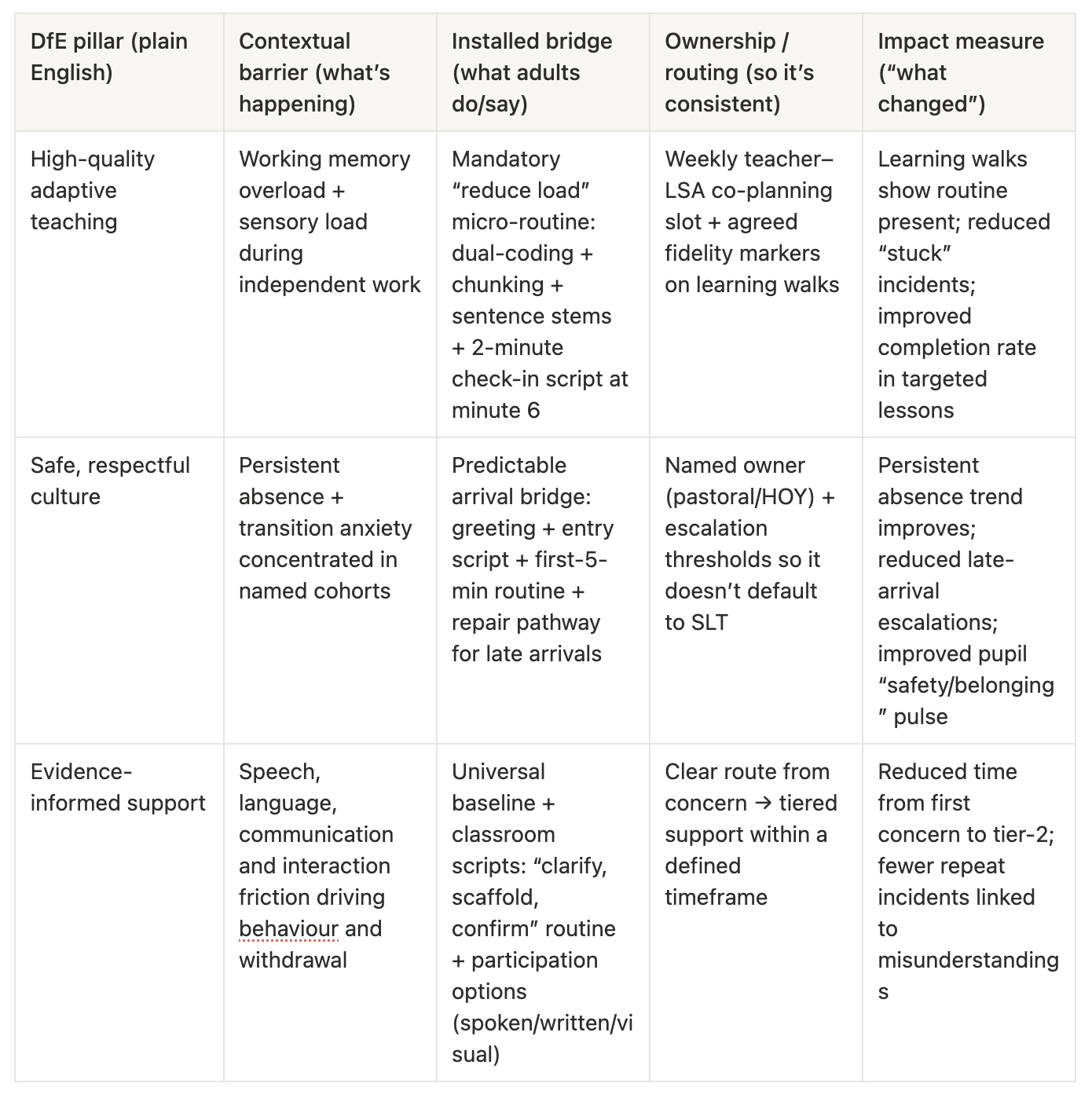
IMF inclusion strategy: from “barriers” to installed routines (and evidence)
Your inclusion strategy statement must stand up to:
governance scrutiny (governors/trustees)
publication expectations (parent-facing clarity)
inspection questions (“What changed?” / “How do you know?”)
A practical model that holds is:
Contextual barrier → Installed bridge (routine + language) → Ownership/routing → Impact measure

Home ↔ school continuity: the “dragon” is transition load + recovery tail
The friction you see in school doesn’t stop at the gate. Home hot windows (mornings, after-school decompression, bedtime, screen-off) create the recovery tail that shows up in school as:
dysregulated arrivals
attendance instability
quicker escalation under ordinary demand
increased reliance on pastoral “containment”
In AmbiSense terms, the “dragon” isn’t “bad behaviour”. It’s transition load + recovery tail. The win isn’t perfect compliance — it’s faster recovery with dignity.
AmbiSense®: emotional safety as infrastructure (installed, not bolted on)
AmbiSense® is a psychology-led emotional infrastructure system that makes safety, regulation, language, and repair repeatable at the points the day most often breaks.
We don’t start with “what’s wrong with this child?”
We start with: Where does the day keep breaking — and what bridge would stop the break?
What gets installed (so it survives September)
Hot-window mapping: identify the 1–2 transitions where escalation is most predictable and costly
Calm Bridge routines: step-by-step DO/SAY sequences adults can run under pressure without second-guessing
Routing + ownership: so emotional heat doesn’t dump into the same people or escalate upward by default
Repair scripts: quick-recovery dialogues that return learning while keeping dignity intact
Micro-practice cadence: 5 minutes weekly inside an existing meeting/huddle
What leaders notice first (micro-proof, real-world signals)
fewer repeated escalations at the same time each day
reduced “radioing for help” / interruptions upward
calmer, more consistent boundary-setting across adults
faster return to learning after rupture (shorter recovery tails)
The September-ready plan: a 30-day minimum viable installation
You don’t need a massive transformation programme. You need a minimum viable installation that creates visible consistency.
⏱️
30-day install promise: In one named hot window, you’ll have (1) a clear friction map, (2) a working bridge routine (DO/SAY + sequence), (3) routing/ownership so heat doesn’t dump into the same people, and (4) baseline → post measures that show recovery improving.</aside>
Light measures (evidenceable, leader-friendly)
Pick 3–5:
hot-window incidents (count)
time-to-recovery (TTR) (minutes, or bands)
interruptions upward (SLT/DSL/pastoral pulls)
recovery tail marker (repeat incident within 2 hours)
staff confidence-under-strain pulse (1–5)
The infrastructure reflection prompt (use in planning meetings)
As you set inclusion priorities for 2026/27, ask:
Where does our system lose consistency first? (language, boundaries, routing, adult confidence)
Which hot window costs us the most learning time and senior bandwidth?
What would make September easier by October if it held consistently?
How MATs and schools work with me (AmbiSense® routes)
Route A — Inclusion Strategy Sprint (publish-ready + usable + inspection-aware)
inclusion strategy statement drafted for publication
internal working version (what you will actually do)
30–60–90 day plan + ownership
evidence trail: noticed → decided → changed → tracked
Route B — Hot-Window Installation (30 days)
pick one high-cost hot window
install Calm Bridge routine + routing + repair
baseline → post scorecard + playback
Route C — Trust-wide continuity build (MAT)
multi-site transition load audit
install bridges at highest-cost windows
embedment cadence + induction integration
Enquiries
If you’re planning your 2026/27 inclusion budget and want an approach that builds capacity, consistency and evidence, email naomi.withers@thehrologist.co.uk.
Include:
your setting/trust type
your highest-cost hot window (if known)
IMF / IEYF / both
Suggested email subject line:
“IMF — September-ready inclusion plan”
“Hot window install — arrivals/transitions/re-entry”
