CalmCards ™️

£29.00

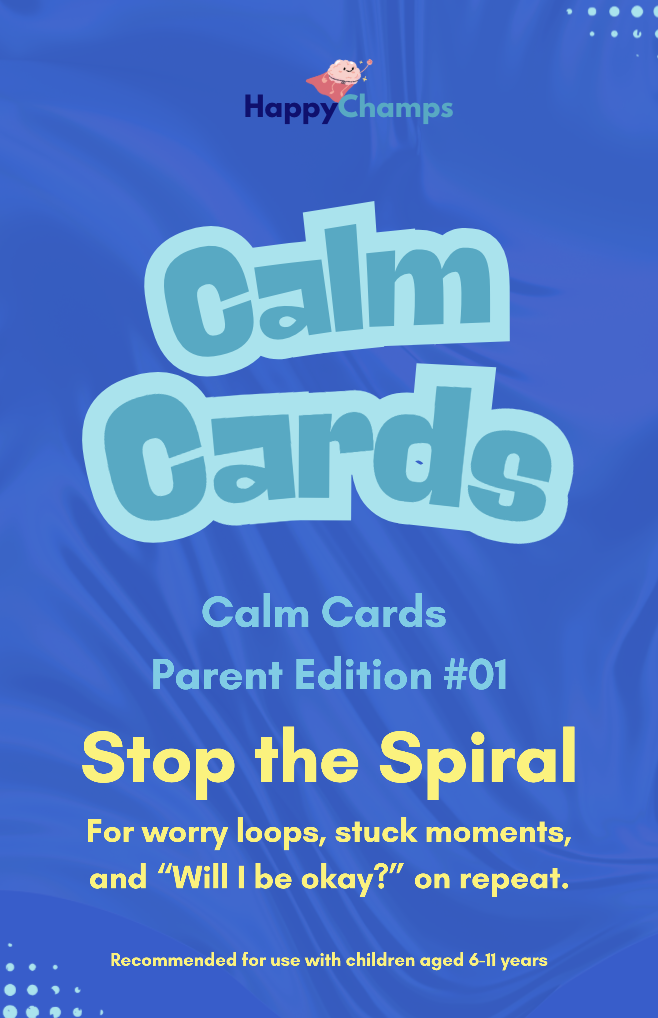
Calm Cards™ are evidence-based emotional regulation cards for children who struggle with anxiety, overwhelm, meltdowns or “big feelings”.

Built using CBT and DBT principles, they give parents (and teachers) simple, step-by-step strategies you can use in real-life moments -  even when everyone’s exhausted.

Parenting a child with big emotions can feel overwhelming.

Some days you hold it together.
Some days you snap and feel guilty.
Some days you just wish someone would tell you exactly what to do in that moment.

Calm Cards™ were created for those moments.

These are not fluffy affirmations or vague “stay calm” reminders.
They’re practical, evidence-based micro-strategies you can use when your child is:

  • anxious

  • overwhelmed

  • melting down

  • shutting down

  • rigid, oppositional, or stuck

Think of them as emotional PPE for parents and carers.
Micro-strategies for macro-meltdowns.

What are Calm Cards™?

Calm Cards™ are a set of emotional regulation prompt cards designed for:

  • parents and carers

  • teachers and support staff

  • anyone supporting children with big feelings or neurodivergent profiles (ADHD, autism, PDA traits, sensory needs, etc.)

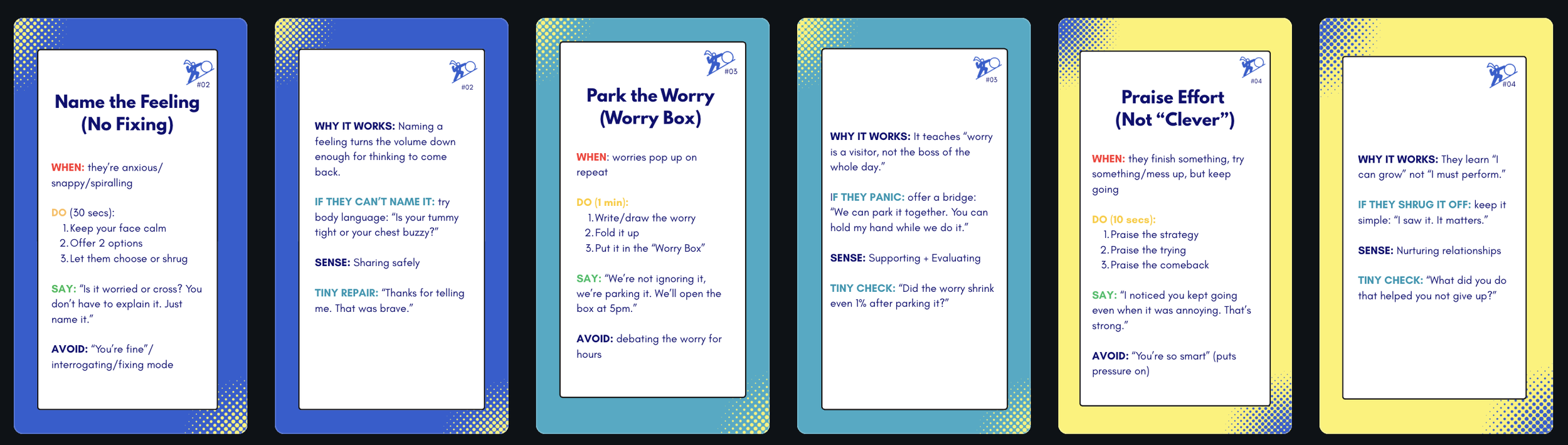
Each card gives you:

  • One simple strategy you can use in the moment

  • A short, clear instruction so you don’t have to think when you’re stressed

  • A brief explanation of why it works, based on CBT and DBT principles

You don’t need training.
You don’t need a psychology degree.
You just need something you can actually use when emotions are running high.

Built on CBT + DBT (without the jargon)

Calm Cards™ are designed using:

  • CBT (Cognitive Behavioural Therapy) – helping children notice thoughts, challenge worries, and build confidence through small wins.

  • DBT (Dialectical Behaviour Therapy) – supporting emotional regulation, distress tolerance and communication in high-stress moments.

Every strategy has been translated into simple, real-life language so any parent, teacher or trusted adult can pick up a card and know what to do within seconds.

This isn’t therapy.
It’s the bridge between a meltdown and a moment of connection.

What’s inside the Calm Cards™ deck?

(Adjust numbers when you finalise the set.)

  • 24 Calm Cards covering:

    • grounding and nervous system resets

    • co-regulation and connection

    • worry and anxiety strategies

    • distress tolerance and “riding the wave”

    • communication and de-escalation

    • micro-moment routines you can repeat daily

  • Crisis vs Maintenance cards

    • Crisis: “Use these mid-meltdown”

    • Maintenance: “Use these to build emotional skills over time”

  • Quick-start guide
    A one-page overview so you know exactly where to start and how to introduce the cards to your child.

  • Ideas for parents + teachers
    Tips on how to use Calm Cards at home, in the classroom, or in small groups.

Who are Calm Cards™ for?

Calm Cards are ideal if you’re:

  • parenting a child who often feels anxious, overwhelmed, or “too much”

  • supporting a child with ADHD, autism or sensory differences

  • navigating school refusal, shutdowns or meltdowns

  • a teacher, TA or SENCO looking for quick, trauma-informed strategies

  • exhausted from trying everything and thinking, “I don’t know what to do anymore.”

You don’t have to be “the perfect parent” or “the calm teacher”.
You just need a plan you can reach for when things get tough.

How to use Calm Cards™

There’s no one right way, but here are some simple starting points:

For parents:

  • Keep the cards on the fridge, bedside table, or in a visible spot

  • When emotions rise, grab one crisis card and follow it step by step

  • Use maintenance cards during quieter moments to build emotional skills and confidence

  • Pick one card a week to become your “family focus” and practise it together

For teachers/schools:

  • Keep a set on your desk or in a lanyard pouch

  • Use cards during transition points, sensory overload, or post-incident repair

  • Introduce one strategy at a time in PSHE, form time or small groups

  • Share language from the cards with support staff so you’re all responding consistently

Why Calm Cards™ work

  • They are tiny, doable actions. When you’re overwhelmed, your brain needs small steps, not big theories.

  • They focus on co-regulation, not control. Instead of “fixing” behaviour, they help you reconnect and soothe the nervous system.

  • They reduce guilt and guesswork. No more wondering what to say or do; you’ve got a clear plan in your hand.

  • They are designed for real life. Messy kitchens, tired parents, overstimulated classrooms – not perfect, Instagram-ready homes.

A note from the creator

I grew up in a home where emotions were big and often unsafe.
I know what it feels like to walk on eggshells - and later, to raise children with their own intense inner worlds.

I created Calm Cards™ because in those hardest moments, I didn’t need theory.
I needed one small, compassionate instruction that would help me right now.

These cards are my way of putting that support into your hands.

You don’t need perfection.
You just need a plan.

💛 Calm Cards™ – micro-strategies for macro-meltdowns.

📦 “What’s Included” (for Shopify bullets)

You can also copy this into the “Highlights” or bullet list section.

  • 24x Calm Cards™ with clear, step-by-step strategies

  • Crisis vs Maintenance structure for “right now” vs “long-term” support

  • Quick-start guide for parents and teachers

  • CBT + DBT–informed techniques in simple, friendly language

  • Suitable for parents, carers, teachers, TAs and SEN teams

  • Designed with neurodivergent and highly sensitive children in mind

❓ FAQ Section

You can add these as collapsible FAQ blocks on the product page.

Q: What age are Calm Cards™ suitable for?
A: Calm Cards are designed for adults to use with children, typically from around age 4–5 up to early teens. The strategies can be adapted for younger or older children depending on their developmental stage and communication style.

Q: Are Calm Cards a replacement for therapy?
A: No. Calm Cards are not therapy and don’t replace professional support. They are practical, evidence-informed tools to help you respond more calmly and confidently in emotionally intense moments, and to build emotional skills over time.

Q: Will these work for neurodivergent children (ADHD, autism, PDA)?
A: Calm Cards were created with neurodivergent children very much in mind. Many strategies focus on sensory regulation, co-regulation, predictability and reducing overwhelm. Every child is different, so you can pick and adapt the cards that fit your child best.

Q: Do I need training to use Calm Cards?
A: No. Each card includes a simple instruction and a short explanation. You can literally pick a card and start within seconds, even on a day when you feel completely drained.

Q: Can schools use Calm Cards?
A: Yes. Calm Cards are ideal for teachers, TAs, pastoral staff and SEN teams. They can be used in classrooms, nurture spaces, small groups or one-to-one. Many schools also send a card home with a child to create continuity between home and school.

Calm Cards™ are evidence-based emotional regulation cards for children who struggle with anxiety, overwhelm, meltdowns or “big feelings”.

Built using CBT and DBT principles, they give parents (and teachers) simple, step-by-step strategies you can use in real-life moments -  even when everyone’s exhausted.

Parenting a child with big emotions can feel overwhelming.

Some days you hold it together.
Some days you snap and feel guilty.
Some days you just wish someone would tell you exactly what to do in that moment.

Calm Cards™ were created for those moments.

These are not fluffy affirmations or vague “stay calm” reminders.
They’re practical, evidence-based micro-strategies you can use when your child is:

  • anxious

  • overwhelmed

  • melting down

  • shutting down

  • rigid, oppositional, or stuck

Think of them as emotional PPE for parents and carers.
Micro-strategies for macro-meltdowns.

What are Calm Cards™?

Calm Cards™ are a set of emotional regulation prompt cards designed for:

  • parents and carers

  • teachers and support staff

  • anyone supporting children with big feelings or neurodivergent profiles (ADHD, autism, PDA traits, sensory needs, etc.)

Each card gives you:

  • One simple strategy you can use in the moment

  • A short, clear instruction so you don’t have to think when you’re stressed

  • A brief explanation of why it works, based on CBT and DBT principles

You don’t need training.
You don’t need a psychology degree.
You just need something you can actually use when emotions are running high.

Built on CBT + DBT (without the jargon)

Calm Cards™ are designed using:

  • CBT (Cognitive Behavioural Therapy) – helping children notice thoughts, challenge worries, and build confidence through small wins.

  • DBT (Dialectical Behaviour Therapy) – supporting emotional regulation, distress tolerance and communication in high-stress moments.

Every strategy has been translated into simple, real-life language so any parent, teacher or trusted adult can pick up a card and know what to do within seconds.

This isn’t therapy.
It’s the bridge between a meltdown and a moment of connection.

What’s inside the Calm Cards™ deck?

(Adjust numbers when you finalise the set.)

  • 24 Calm Cards covering:

    • grounding and nervous system resets

    • co-regulation and connection

    • worry and anxiety strategies

    • distress tolerance and “riding the wave”

    • communication and de-escalation

    • micro-moment routines you can repeat daily

  • Crisis vs Maintenance cards

    • Crisis: “Use these mid-meltdown”

    • Maintenance: “Use these to build emotional skills over time”

  • Quick-start guide
    A one-page overview so you know exactly where to start and how to introduce the cards to your child.

  • Ideas for parents + teachers
    Tips on how to use Calm Cards at home, in the classroom, or in small groups.

Who are Calm Cards™ for?

Calm Cards are ideal if you’re:

  • parenting a child who often feels anxious, overwhelmed, or “too much”

  • supporting a child with ADHD, autism or sensory differences

  • navigating school refusal, shutdowns or meltdowns

  • a teacher, TA or SENCO looking for quick, trauma-informed strategies

  • exhausted from trying everything and thinking, “I don’t know what to do anymore.”

You don’t have to be “the perfect parent” or “the calm teacher”.
You just need a plan you can reach for when things get tough.

How to use Calm Cards™

There’s no one right way, but here are some simple starting points:

For parents:

  • Keep the cards on the fridge, bedside table, or in a visible spot

  • When emotions rise, grab one crisis card and follow it step by step

  • Use maintenance cards during quieter moments to build emotional skills and confidence

  • Pick one card a week to become your “family focus” and practise it together

For teachers/schools:

  • Keep a set on your desk or in a lanyard pouch

  • Use cards during transition points, sensory overload, or post-incident repair

  • Introduce one strategy at a time in PSHE, form time or small groups

  • Share language from the cards with support staff so you’re all responding consistently

Why Calm Cards™ work

  • They are tiny, doable actions. When you’re overwhelmed, your brain needs small steps, not big theories.

  • They focus on co-regulation, not control. Instead of “fixing” behaviour, they help you reconnect and soothe the nervous system.

  • They reduce guilt and guesswork. No more wondering what to say or do; you’ve got a clear plan in your hand.

  • They are designed for real life. Messy kitchens, tired parents, overstimulated classrooms – not perfect, Instagram-ready homes.

A note from the creator

I grew up in a home where emotions were big and often unsafe.
I know what it feels like to walk on eggshells - and later, to raise children with their own intense inner worlds.

I created Calm Cards™ because in those hardest moments, I didn’t need theory.
I needed one small, compassionate instruction that would help me right now.

These cards are my way of putting that support into your hands.

You don’t need perfection.
You just need a plan.

💛 Calm Cards™ – micro-strategies for macro-meltdowns.

📦 “What’s Included” (for Shopify bullets)

You can also copy this into the “Highlights” or bullet list section.

  • 24x Calm Cards™ with clear, step-by-step strategies

  • Crisis vs Maintenance structure for “right now” vs “long-term” support

  • Quick-start guide for parents and teachers

  • CBT + DBT–informed techniques in simple, friendly language

  • Suitable for parents, carers, teachers, TAs and SEN teams

  • Designed with neurodivergent and highly sensitive children in mind

❓ FAQ Section

You can add these as collapsible FAQ blocks on the product page.

Q: What age are Calm Cards™ suitable for?
A: Calm Cards are designed for adults to use with children, typically from around age 4–5 up to early teens. The strategies can be adapted for younger or older children depending on their developmental stage and communication style.

Q: Are Calm Cards a replacement for therapy?
A: No. Calm Cards are not therapy and don’t replace professional support. They are practical, evidence-informed tools to help you respond more calmly and confidently in emotionally intense moments, and to build emotional skills over time.

Q: Will these work for neurodivergent children (ADHD, autism, PDA)?
A: Calm Cards were created with neurodivergent children very much in mind. Many strategies focus on sensory regulation, co-regulation, predictability and reducing overwhelm. Every child is different, so you can pick and adapt the cards that fit your child best.

Q: Do I need training to use Calm Cards?
A: No. Each card includes a simple instruction and a short explanation. You can literally pick a card and start within seconds, even on a day when you feel completely drained.

Q: Can schools use Calm Cards?
A: Yes. Calm Cards are ideal for teachers, TAs, pastoral staff and SEN teams. They can be used in classrooms, nurture spaces, small groups or one-to-one. Many schools also send a card home with a child to create continuity between home and school.